


INTRODUCTION
Chronic obstructive pulmonary disease (COPD) is a major global cause of morbidity and mortality, which imposes heavy tolls on health and financial costs1. Particularly in low- and middle-income nations where tobacco use, biomass fuel exposure, and underdiagnosis remain common concerns, COPD frequency has progressively increased2. Although COPD affects people all around the world, there is significant variation in clinical presentation, treatment approaches, and patient outcomes across different areas that emphasizes the importance of localized data to direct clinical decisions and policymaking3.
In Indonesia, COPD also poses a major public health concern. National-level statistics, however, lack a thorough description of the demographics, clinical features, treatment strategies, and disease course of COPD patients. Most recent studies have limited their scope to single-center observations or specific subpopulations, which may not accurately reflect the national COPD landscape. The Indonesian COPD Registry was created to systematically collect and evaluate real-world data from several pulmonology facilities affiliated with the Indonesian Society of Respirology (ISR) to close these gaps. The main goals of the registry are to define the clinical characteristics, demographic profiles, and management strategies of COPD patients nationwide. It also seeks to identify year-to-year trends reflecting changes in clinical severity, demographics, and therapeutic approaches. These data are essential for guiding national policies, improving patient treatment, and identifying areas that require further research and allocation of healthcare resources.
This multicenter registry provides an overview of COPD patient characteristics in Indonesia from 2022 to 2024. These data offer evidence into national disease patterns, treatment practices, and evolving clinical trends in a population historically underrepresented in global COPD research. This registry also represents one of the first, large-scale Indonesian COPD data registries, collected by pulmonologist all over Indonesia.
METHODS
Study design and setting
This was a multicenter, registry of patients with COPD managed at pulmonology clinics and hospitals affiliated with the ISR. Data were collected between January 2022 to September 2024. Because each enrolment year comprised a separate cross-section of patients rather than longitudinal follow-up of the same individuals, differences across years are interpreted as changes in sample composition, not within-patient change over time.
Participating centers and recruitment
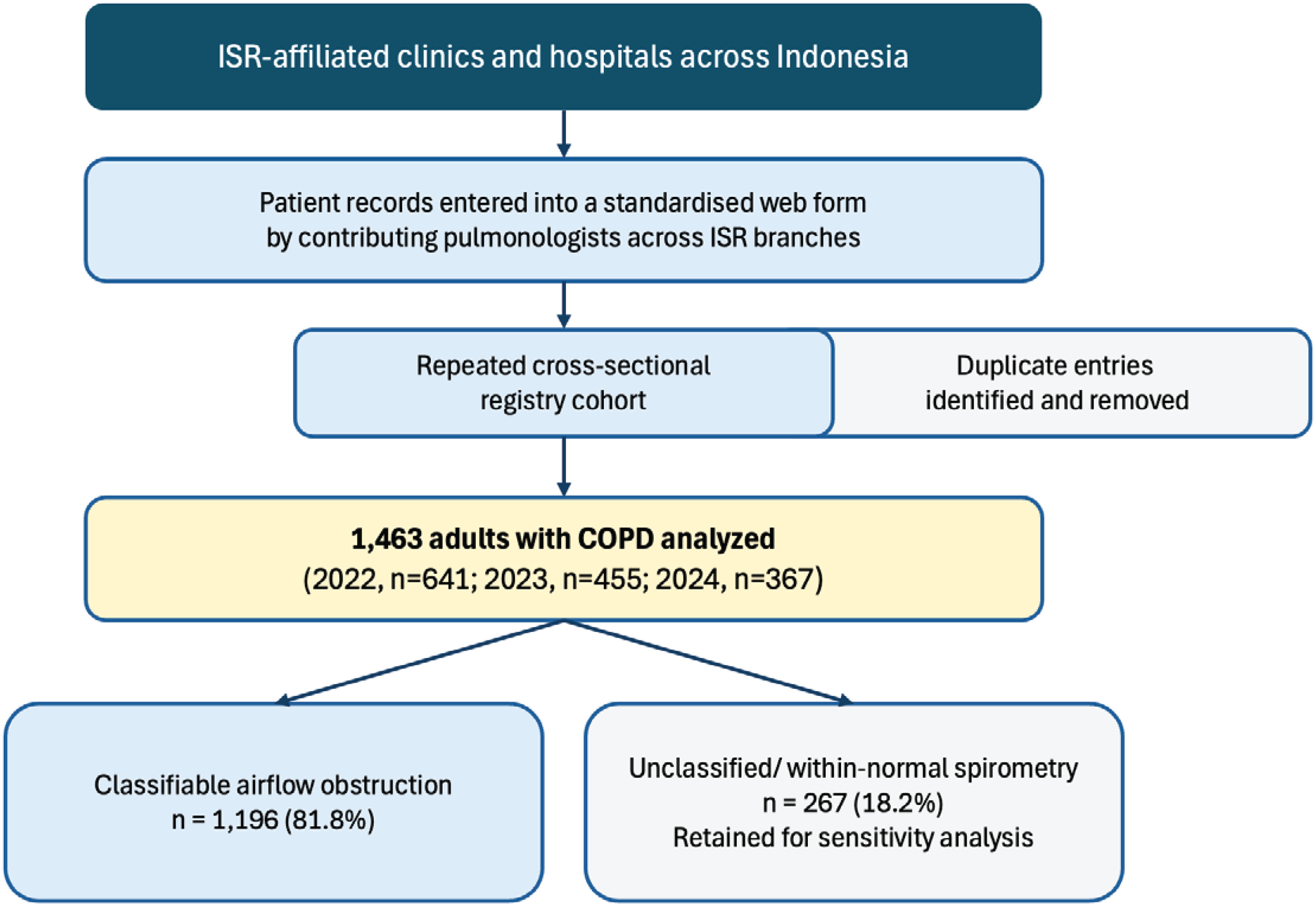
Data were contributed by approximately 200 pulmonologists across 26 provincial ISR branches spanning Sumatra, Java, Bali-Nusa Tenggara, Kalimantan, Sulawesi, and Maluku. Participation and patient enrolment were entirely voluntary with no consecutive or systematic-sampling protocol, which we acknowledge as a potential source of selection bias. Both prospectively and retrospectively identified patients were entered through a single standardized Google Form. The database did not flag the recruitment pathway, so their relative contributions could not be quantified (see Limitations). Contributing facilities included government (59.9%) and non-government (40.1%) hospitals, and most patient were covered by national insurance (86%). Duplicate entries were identified and removed before analysis.
Participants and eligibility
Eligible participants were adults (aged ≥18 years) with COPD diagnosed on clinical evaluation and spirometry according to the GOLD guidelines in force at the time of assessment; patients of all GOLD stages and groups were eligible. The study adhered to the Declaration of Helsinki, participants provided informed consent, and the protocol was approved by the Health Research Ethics Committee of Saiful Anwar General Hospital, Malang (IRB No. 400/223/K.3/102.7/2022), with local ethical clearance obtained at each participating center.
Data collections and variables
Participating pulmonologists entered data into a standardized web-based (Google Form). Variables comprised demographics (age, sex, birthplace, residence, hospital type, insurance), smoking status and cumulative exposure (Brinkman index), anthropometry (weight, height, and BMI, categorized by WHO cutoffs), spirometric classifications, GOLD group, comorbidities, pharmacological treatment, non-pharmacological interventions, and complications. Pharmacological treatment was recorded as the single predominant regimen, so the treatment categories are mutually exclusive and sum to the full cohort. Regimens not represented by these categories were not captured separately. Non-pharmacological interventions allowed more than one selection per patient. Comorbidities were recorded as the principal physician-reported condition based on known clinical history rather than systematic screening. Consequently, the dataset captures predominantly one condition per patient and may under-represent multimorbidity.
GOLD classification
Patients were assigned to GOLD groups A–D using the ABCD framework applicable during the study period. The symptom burden (mMRC/CAT) and exacerbation history underlying these assignments were evaluated by the treating pulmonologist and recorded as the resulting group rather than as individual scores or exacerbation counts. To improve comparability with the current framework, patients were additionally mapped to the GOLD ABE scheme, in which former groups C and D are combined into group E.
Statistical analysis
Continuous variables are summarized as mean and standard deviation or, for skewed distributions, median and interquartile range (IQR); categorical variables are presented as frequencies and percentages. Differences across enrolment years (2022–2024) were assessed with the chi-squared test for categorical variables and one-way ANOVA or the Kruskal-Wallis test for continuous variables, as appropriate. To extend the analysis beyond description, we fitted an exploratory multivariable logistic regression for chronic respiratory failure, with age, sex, severe (severe/very severe) airflow obstruction, BMI, and presence of comorbidity as covariates (the Brinkman index was not included because near-universal smoking exposure rendered it strongly collinear with sex). Results are reported as odds ratios (ORs) with 95% CI and discrimination as the area under the ROC curve (AUC). A sensitivity analysis repeated the principal descriptive estimates after excluding patients with unclassified or within-normal-limit spirometry. Missing data were handled by complete-case analysis, with the number of observations reported for each analysis. Given the descriptive design, no adjustment for multiple comparisons was applied, and year-related p-values should be interpreted accordingly. Analysis was performed using SPSS 26, with two-sided p<0.05 considered statistically significant.
RESULTS
A total of 1463 patients with COPD were analyzed (2022, n=641; 2023, n=455; and 2024, n=367) (Figure 1). The mean age was 65.2 ± 11.7 years, and most were male (78.7%, n = 1,151). Among women, 25 of 312 (8.0%) were ever smokers, compared with 1011 of 1151 (87.8%) of men. Based on the GOLD ABCD classification, Group B was the most common (38.9%, n= 569), followed by Group D (25.7%, n=376), Group C (22.3%, n=326), and Group A (13.1%, n=192). Under the ABE scheme, 702 patients (48.0%) were classified as group E (former C and D combined). Moderate obstruction was the most frequent spirometric finding (32.5%, n=475), followed by severe obstruction (21.5%, n=314), mild obstruction (15.0%, n=219), and very severe obstruction (12.8%, n=188). Approximately 18.2% of patients (n=267) had either unclassified or within-normal-limits spirometry results. Complete demographic data can be seen in Table 1. Severe and very severe obstruction were concentrated in groups C and D (p<0.001) (Table 2).
Table 1
Baseline demographic, clinical, and therapeutic characteristics of participants (N=1463)
| Characteristics | n (%) |
|---|---|
| Sex | |
| Male | 1151 (78.7) |
| Female | 312 (21.3) |
| Age (years), mean ± SD | 65.2 ± 11.7 |
| BMI (kg/m2) | |
| Underweight | 310 (21.2) |
| Normal weight | 852 (58.2) |
| Overweight | 239 (16.3) |
| Obese | 55 (3.8) |
| Mean ± SD | 21.7 ± 4.4 |
| Brinkmann index | |
| Non-smoker | 472 (32.3) |
| Smoker | 991 (67.7) |
| Light | 204 (13.9) |
| Moderate | 373 (25.5) |
| Heavy | 414 (28.3) |
| Median (IQR) | 300 (0–600) |
| GOLD group (ABCD) | |
| A | 192 (13.1) |
| B | 569 (38.9) |
| C | 326 (22.3) |
| D | 376 (25.7) |
| GOLD group (ABE) | |
| A | 192 (13.1) |
| B | 569 (38.9) |
| E (former C + D) | 702 (48.0) |
| Spirometric severity | |
| Mild | 219 (15.0) |
| Moderate | 475 (32.5) |
| Severe | 314 (21.5) |
| Very severe | 188 (12.8) |
| Unclassified /within normal limits | 267 (18.2) |
| Comorbidities | |
| None | 617 (42.2) |
| Hypertension | 467 (31.9) |
| Congestive heart failure | 127 (8.7) |
| Diabetes mellitus | 67 (4.6) |
| Tuberculosis (incl. history) | 56 (3.8) |
| Asthma | 14 (1.0) |
| GERD | 13 (0.9) |
| Other | 113 (7.7) |
| Pharmacological treatment | |
| LABA | 243 (16.6) |
| LAMA | 226 (15.4) |
| LABA + ICS | 606 (41.4) |
| LABA + LAMA | 187 (12.8) |
| LABA + LAMA + ICS | 201 (13.7) |
| Non-pharmacological intervention† | |
| Smoking cessation support | 792 (54.1) |
| Pulmonary rehabilitation | 414 (28.3) |
| Nutritional support | 343 (23.5) |
| Vaccination | 44 (3.0) |
| Other | 44 (3.0) |
| None | 34 (2.3) |
| Complications | |
| None | 1191 (81.4) |
| Chronic respiratory failure | 211 (14.4) |
| Cardiac disease | 21 (1.4) |
| Chronic cor pulmonale | 10 (0.7) |
| Other | 30 (2.1) |
† Patients could receive more than one non-pharmacological intervention; percentages therefore exceed 100%. GOLD: Global Initiative for Chronic Obstructive Lung Disease. LABA: long-acting β2-agonist. LAMA: long-acting muscarinic antagonist. ICS: inhaled corticosteroid. GERD: gastro-esophageal reflux disease. IQR: interquartile range. BMI: body mass index.
Table 2
Spirometric severity by GOLD group among participants (N=1463)
The 267 patients with unclassified or within-normal-limits spirometry comprised those whose values were not assignable to a GOLD spirometry grade or fell within normal limits despite a documented clinical diagnosis of COPD. These patients were retained because diagnosis rested on the treating pulmonologist’s combined clinical and spirometry assessment. In a sensitivity analysis restricted to the 1196 patients with confirmed airflow obstruction, the distributions were essentially unchanged (i.e. LABA + ICS 41.1% vs 41.4%; GOLD groups within 1–2 percentage points). This indicates that their inclusion did not significantly bias the findings.
No comorbidities were reported in 42.2% of patients (n=617). Hypertension was the most prevalent comorbidity (31.9%, n=467), followed by congestive heart disease (8.7%, n=127), diabetes mellitus (4.6%, n=67), tuberculosis (including history of tuberculosis) (3.8%, n=56), asthma (1.0%, n=14), and gastro-esophageal reflux disease (GERD) (0.9%, n=13). Because comorbidities were recorded as the principal condition, categories were largely mutually exclusive and multimorbidity (≥2 recorded conditions; 0.5%) was under-captured. Nonetheless, comorbidity burden increased with clinical severity; at least, one comorbidity was present in 49.0% of group A versus 67.6% of group D (p<0.001) (Table 3).
Table 3
Comorbidity prevalence by GOLD group among participants (N=1463)
Pharmacological treatment, recorded as the single predominant routine regimen, most often comprised a long-acting β2-agonist plus inhaled corticosteroid (LABA + ICS, 41.4%, n=606), followed by LABA alone (16.6%, n=243), a long-acting muscarinic antagonist (LAMA, 15.4%, n=226), LABA + LAMA + ICS (13.7%, n=201), and LABA + LAMA (12.8%, n=187). Treatment differed by GOLD group (p<0.001) (Table 4). Triple therapy (LABA+LAMA+ICS) increased from 5.2% in group A to 27.7% in group D, while LABA monotherapy fell from 26.6% to 6.9%. LABA+ICS remained common across all groups (40–44%), including the lower risk groups A and B. Non-pharmacological interventions (more than one possible per patient) included smoking cessation support (54.1%, n=792), pulmonary physical rehabilitation (28.3%, n=414), nutritional support (23.5%, n=343), and vaccination (3.0%, n=44). Only 2.3% (n=34) reported receiving no non-pharmacological interventions.
Table 4
Pharmacological treatment by GOLD group among participants (N=1463)
Mean BMI was 21.7 ± 4.4 kg/m², with 21.2% were underweight, 58.2% were normal weight, 16.3% as overweight, and 3.8% obese. Cumulative smoking exposure (Brinkman index) was right-skewed and is summarized as a median of 300 (IQR: 0–600); patients were further grouped as non-smokers or minimal exposure (32.3%), light smokers (13.9%), moderate smokers (25.5%), and heavy smokers (28.3%) , consistent with the smoking-status field.
Most patients (81.4%, n=1191) had no reported complications. Among those who did, chronic respiratory failure was the most common complication (14.4%, n=211), followed by cardiac diseases (1.4%, n=21), and chronic cor pulmonale (0.7%, n=10).
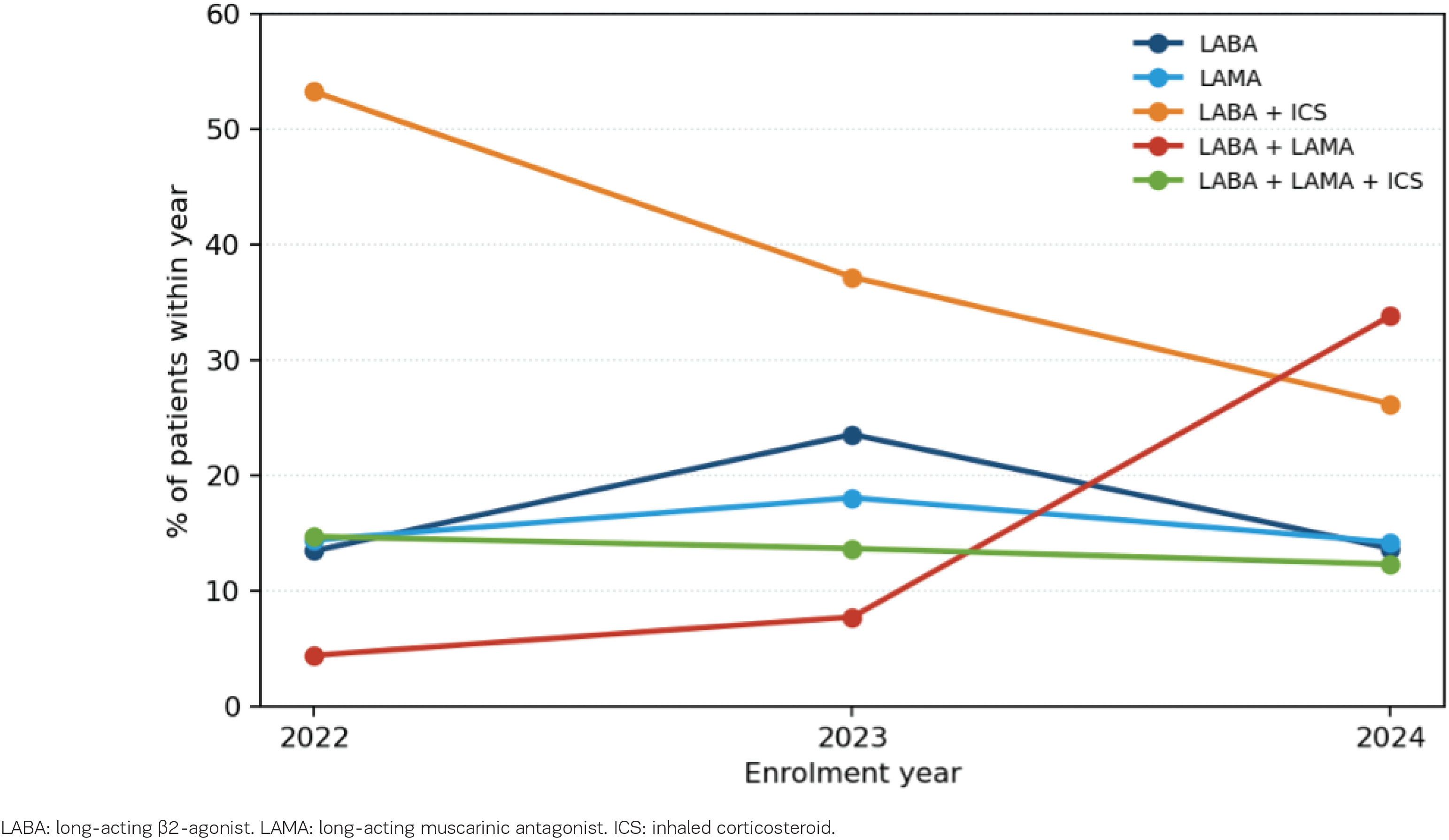
Across enrolment years, mean age differed significantly (66.7, 62.7, and 65.8 years in 2022, 2023, and 2024, respectively; ANOVA p<0.001). The GOLD group distribution also shifted (p<0.001), most notably a rise in group C during 2023 (40.9% vs 18.3% in 2022 and 6.3% in 2024) (Figure 2). Because each year is a separate cross-section, this most likely reflects year-to-year differences in the mix of contributing centers and patients rather than a true temporal trend. The proportion receiving LABA+ICS declined progressively from 53.2% in 2022 to 37.1% (2023) and 26.2 % (2024) (p<0.001) (Figure 3).
Figure 2
Distribution of GOLD groups by enrolment year (N=1463; chi-squared p<0.001). Group B remained predominant; group C peaked in 2023. Year-to-year differences reflect variation in sample composition rather than longitudinal change
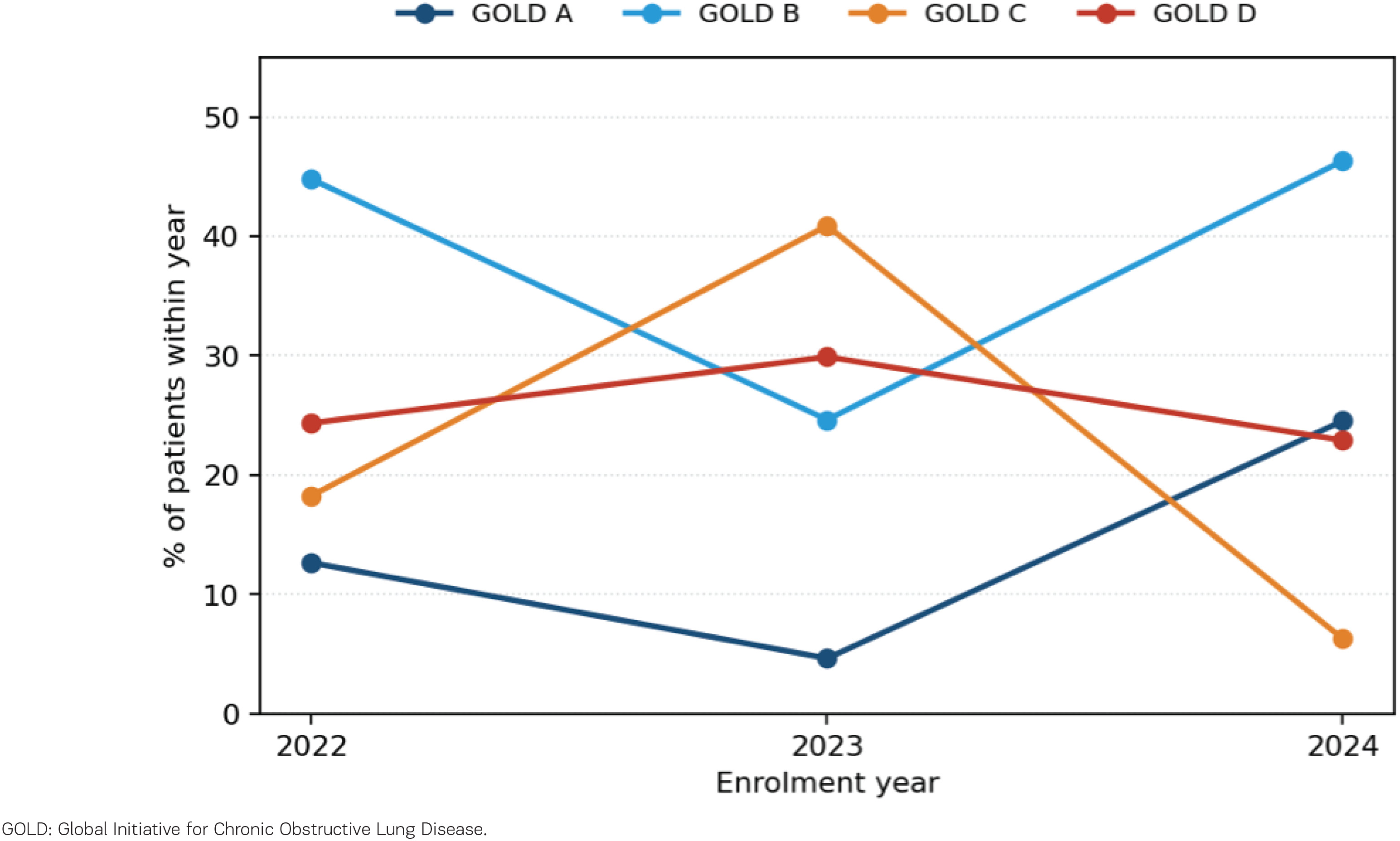
Figure 3
Distribution of pharmacological treatment by enrolment year (N=1463; chi-squared p<0.001). LABA+ICS remained the most frequent regimen but declined from 53.2% (2022) to 26.2% (2024)
In an exploratory multivariable model among patients with classifiable spirometry (n=1183; 189 events), chronic respiratory failure was independently associated with older age (OR=1.02 per year, 95% CI: 1.00–1.03) and severe/very severe airflow obstruction (OR=1.65; 95% CI: 1.21–2.26). Sex, BMI, and the presence of comorbidity were not independently associated, and discrimination was modest (AUC =0.60).
DISCUSSION
This multicenter registry characterized 1463 patients with COPD, enrolled across 26 Indonesian provincial ISR branches between 2022 and 2024. The sample was predominantly older and male with a heavy cumulative smoking burden. Most patients were in GOLD group B or presented with moderate-to-severe airflow obstruction, and hypertension was the leading comorbidity. Long acting β2-agonist plus inhaled corticosteroid (LABA+ICS) was the most frequently recorded regimen, including among lower risk patients. To our knowledge, this is one of the first large-scale, multicenter descriptions of COPD in Indonesia. We interpret these descriptive findings within the Indonesian context rather than as broad generalization of all low- and middle- income countries (LMICs).
The study revealed a striking male predominance (78.7%), which fits the high incidence of tobacco smoking among Indonesian men. As per the 2021 Global Adult Tobacco Survey, nearly 60% of Indonesian males are current smokers, which accounts for one of the highest rates globally4. This gender disparity highlights smoking as the main risk factor for COPD incidence in Indonesia and may reflect similar results of other studies on Southeast Asia5. Although the high proportion of heavy smokers do not by themselves establish the impact of specific interventions, they support the relevance of smoking-cessation efforts in this population. Although these were not specifically recorded in the registry, additional factors including biomass fuel exposure, occupational risks, and ambient air pollution may also play significant roles in the disease progression of COPD. Future research is warranted in this regard.
The mean age of the participants (65.2 years) aligns with global registry data, where the mean ages frequently fall between 60 and 70 years. With clinical, symptomatic disease often develops later years of life, this age range emphasizes the chronic, progressive character of COPD6. The lower mean age observed in 2023 should not be read as a biological trend, because each year represents a separate cross-section. Such differences most plausibly reflect year-to-year variation in the mix of contributing centers and patients.
Body mass index (BMI) analysis revealed that a significant proportion of patients were either underweight or of normal weight, with a relatively low prevalence of overweight and obese individuals. This distribution reflects patterns commonly observed in COPD populations, where muscle wasting and nutritional deficits are prevalent7. The relatively high prevalence of underweight patients highlights the ongoing challenge of malnutrition and sarcopenia in COPD, particularly in LMICs. This phenomenon has been associated with poorer survival outcomes and increased exacerbation risk, emphasizing the importance of nutritional assessment and intervention in COPD management.
Analysis of smoking exposure, as measured by the Brinkman Index, demonstrated that a large proportion of patients had moderate to heavy smoking histories. This reflects the well-established role of tobacco smoke as the primary etiological factor in COPD pathogenesis8. Persistent high cumulative smoking exposure has been consistently associated with more severe airflow limitation, increased comorbidity burden, and poorer clinical outcomes. These findings underscore the importance of smoking cessation support, particularly in populations with historically high tobacco consumption. Moreover, a previous study has linked high Brinkman scores with greater declines in lung function and elevated mortality risk9, further emphasizing the need for targeted smoking cessation strategies within this patient cohort.
The predominance of GOLD Group B (38.9%) suggests that many patients present with notable symptoms but relatively infrequent exacerbations. Other real-world COPD cohorts have also documented this trend, which may represent a combination of underreporting of exacerbations and delayed diagnosis10. The relatively high proportion in group C and its apparent peak in 2023 are difficult to interpret given the repeated cross-sectional design and most likely reflect changes in sample composition across years rather than a genuine shift in disease profile. Because group C is eliminated under the 2023 GOLD ABE scheme, we additionally mapped patients to ABE (group E, 48.0%). Adopting ABE in future cycles will improve comparability with contemporary data and reduce ambiguity from the former group C/D split. Moderate obstruction (32.5%) was the most common spirometry severity classification in this registry, but the relatively high percentage of patients with severe or very severe obstruction (34.3% combined) points to a concerning degree of disease progression at presentation, which may result from underdiagnosis and limited access to early screening of COPD in Indonesia.
Hypertension was the most common comorbidity (31.9%), followed by diabetes mellitus and cardiovascular disorders. This trend is in line with a lot of research that highlight the cardiovascular burden on COPD patients11. Cardiovascular comorbidities, particularly hypertension, remain a major concern given their contribution to increased hospitalization risk and mortality in COPD populations12. Though may be attributed to underdiagnosis, the rather low prevalence of asthma (1.0%) and GERD (0.9%) suggest a lower rate of asthma-COPD overlap (ACO) subtypes in this registry, compared with Western populations. As comorbidities were recorded as a single principal condition, multimorbidity is under-captured. Nonetheless, the proportion with at least one comorbidity rose with clinical severity (49.0% in group A vs 67.6% in group D), underscoring the requirement of integrated, multidisciplinary treatment approaches in this population13.
The combination of LABA+ICS was the most frequent therapy in the pharmacological management of COPD in this registry (41.4%), followed by LABA and LAMA monotherapies. This also includes the lower risk groups A and B, where ICS-containing therapy is generally not first-line. This pattern suggests possible over-use of ICS relative to current GOLD recommendations, which reserve ICS for patients with frequent exacerbations or elevated blood eosinophils14-16. We could not directly assess the appropriateness of these regimens because blood eosinophil counts and structured exacerbation histories were not captured (which was an important limitation). The lower proportion of LABA+ICS in later years is consistent with, but does not establish, increasing guideline concordance; as the data are repeated cross-sections, this apparent decline may instead reflect changing sample composition, and we therefore interpret it cautiously rather than as a definite shift in prescribing.
In an exploratory multivariable model, older age and severe/very severe airflow obstruction were independently associated with chronic respiratory failure, whereas sex, BMI, and comorbidity were not; discrimination was modest (AUC=0.60). These hypothesis-generating findings align with expected clinical relationships and should be confirmed in future analyses.
Smoking cessation support was the most common non-pharmacological intervention (54.1%), which is encouraging given their great relevance in modifying disease progression17. Still, the low vaccination rate (3.0%) and relatively modest rates of pulmonary rehabilitation and nutritional support may point to clear, addressable gaps in preventive and supportive COPD care in Indonesia.
Taken together, the high smoking burden, advanced severity at presentation, and under-use of preventive and rehabilitative care highlight potential priorities for COPD care in Indonesia, which includes strengthened smoking-cessation services, earlier detection (including wider access to spirometry), and improved access to vaccination and pulmonary rehabilitation.
Limitations
This study has several limitations. First, participation and enrolment were voluntary, with no systematic sampling. Second, the cross-sectional design of this registry precludes within-patient and causal inference, and year-to-year differences are best understood as changes in sample composition. Third, prospectively and retrospectively entered records were not distinguished in the database, so their relative contributions could not be quantified. Fourth, GOLD groups were recorded as the treating physician’s final assignment rather than as individual mMRC/CAT scores or exacerbation counts, and assessment occurred at registry entry rather than necessarily before treatment initiation. Fifth, several variables were not captured (i.e. blood eosinophil counts, structured exacerbation and hospitalization histories, and environmental exposures), limiting assessment of treatment appropriateness and disease determinants. Sixth, comorbidities were recorded as a single principal condition, which under-capture multimorbidity. Finally, the regression was exploratory, with modest discrimination and potential residual confounding.
Future registry cycles should incorporate longitudinal follow-up to capture exacerbations, hospitalizations, and mortality; add blood eosinophils, structured symptom scores (mMRC/CAT), and environmental-exposure data; adopt the GOLD ABE framework; and examine regional variation across Indonesia.
In summary, this registry provides a foundational, country-level description of COPD demographics, severity, comorbidities, and management across Indonesia. It documents a heavy smoking, predominantly older and male population with advanced disease at presentation, frequent ICS-containing therapy even among lower risk patients, and persistent gaps in vaccination and pulmonary rehabilitation. These findings establish a baseline for benchmarking and may support future research and, cautiously, health-policy priorities.
CONCLUSIONS
Indonesia lacks national, multicenter COPD data to guide policy, and real-world gaps in guideline-concordant care and access to spirometry, smoking cessation support, vaccination, and pulmonary rehabilitation are poorly characterized. This registry provides the first country-level profile of COPD across ISR centers (2022–2024), detailing demographics, severity, treatments, and care gaps, and describing regional and year-to-year patterns. The dataset establishes a baseline for benchmarking and monitoring, informs resource allocation and implementation efforts, and enables LMIC-relevant comparative and policy research.