


INTRODUCTION
Chronic obstructive pulmonary disease (COPD) imposes a great threat to both public health and social economy1. It is a heterogeneous lung condition characterized by chronic respiratory symptoms (dyspnea, cough and expectoration) due to persistent abnormalities of the airways and/or alveoli which often result in progressive airflow limitation2. Between 2009 and 2019, the global number of COPD deaths increased by 14.1%3. In 2021, COPD ranked as the fourth leading cause of death globally4. Furthermore, World Health Organization mortality and disease burden projections predict that COPD will re-rank third in global mortality rate by 20305.
Multiple factors contribute to the development of COPD. Smoking is the most important risk factor6. Yang et al.6 estimate that 51% of COPD globally is attributed to tobacco smoke. In addition, male sex and being older than 40 years were among the most significant variables that had an impact on the economic burden of COPD patients7. As a result, smoking COPD male patients aged >40 years may warrant increased attention.
Although previous studies have highlighted the substantial contribution of smoking to COPD burden, the evolving epidemiological patterns and future burden of smoking-attributable COPD among males aged >40 years remain unclear. Understanding these trends across different socioeconomic contexts is crucial for guiding resource allocation and developing targeted prevention strategies. Therefore, this study aimed to comprehensively assess the global burden of smoking-attributable COPD among males aged >40 years from 1990 to 2021 and project its future trends to support evidence-based COPD control policies.
METHODS
Study design
This study is a secondary analysis of data from the Global Burden of Disease (GBD) 2021 study. We utilized publicly available GBD estimates to evaluate the global burden and temporal trends of smoking-attributable COPD among males aged >40 years from 1990 to 2021. The study followed a population-based descriptive epidemiological design, with analyses conducted at global, regional, and national levels. The study is reported according to the Guidelines for Accurate and Transparent Health Estimates Reporting (GATHER) recommendations.
Data source
The data were retrieved from the Global Health Data Exchange GBD Results Tool8. The GBD study provides a freely accessible database containing data on standardized estimates of attributable burdens across a wide range of risk factors for all countries6. GBD 2021 covers 371 diseases and injuries (including 95 communicable, maternal, neonatal, and nutritional diseases, 234 non-communicable diseases, and 40 injuries); 204 countries and territories; 21 countries with subnational locations; 25 age groups; females, males, and both sexes combined; and for the years 1990–20219. Because this study used publicly available, de-identified data, ethical approval and informed consent were not required.
Case definition
COPD is defined according to Global Initiative for Chronic Obstructive Lung Disease (GOLD): post-bronchodilator forced expiratory volume in one second/forced vital capacity (forced expiratory volume in one second/forced vital capacity) < 0.7 on spirometry9. Alternative definitions, including GOLD pre-bronchodilation, lower limit of normal post-bronchodilation, lower limit of normal pre-bronchodilation, and those provided by European Respiratory Society guidelines are also included9. In the GBD study, COPD was defined based on the International Classification of Diseases (ICD) coding system, including ICD-10 codes J41-J44 (chronic bronchitis, emphysema, and chronic obstructive pulmonary disease) and J47 (bronchiectasis), and ICD-9 codes 491-492 (chronic bronchitis and emphysema) and 496 (chronic airway obstruction)9.
Sociodemographic index (SDI)
Developed by GBD researchers, the SDI serves as a composite indicator closely linked with health outcomes. It is calculated as the geometric mean of three indices, each normalized between 0 and 1: the total fertility rate for those aged under 25 years, the mean years of education for individuals aged ≥15 years, and lag-distributed income (LDI) per capita. An SDI value of 0 represents the theoretical minimum level of development pertinent to health, while a value of 1 indicates the theoretical maximum. In GBD 2021, countries were classified10 into five SDI categories: low <0.47; low-middle 0.47–0.62; middle 0.62–0.71; high-middle 0.71–0.81; and high > 0.81.
Statistical analysis
Descriptive analyses were performed to summarize the global burden of smoking-attributable COPD among males aged >40 years from 1990 to 2021. Continuous variables, including the number of cases, deaths, disability-adjusted life years (DALYs), and age-standardized rates per 100000 population (ASRs), are presented as point estimates with corresponding 95% uncertainty intervals (UIs). Categorical variables, including geographical regions, countries, and sociodemographic index (SDI) categories, are summarized using frequencies and percentages, where appropriate.
ASRs were calculated using the direct standardization method based on the following formula:
where αi represents the age-specific rate in age group i, and wi represents the number or weight of individuals in the corresponding age group of the reference standard population11.To evaluate temporal trends in smoking-attributable COPD burden, a linear regression model was applied after logarithmic transformation of ASRs. Specifically, ln (ASR) was modeled as a function of calendar year: Y = α + βX + ε, where Y represents ln (ASR), X represents calendar year, and ε represents the error term. The estimated annual percentage change (EAPC) was calculated as EAPC=100×[exp(β) − 1]. The corresponding 95% confidence intervals (CIs) for EAPC were derived from the regression model. An increasing trend was considered present when both the EAPC and the lower boundary of its 95% CI were >0, whereas a decreasing trend was considered present when both the EAPC and the upper boundary of its 95% CI were <0. Otherwise, the trend was considered stable.
In accordance with the GBD framework, uncertainty was quantified using 95% UIs generated from 1000 posterior draws. The lower and upper limits of the 95% UI corresponded to the 2.5th and 97.5th percentiles of the 1000 draws, respectively12. No hypothesis testing was performed; therefore, a conventional statistical significance threshold was not applicable. All analyses and visualizations were performed using R statistical computing software (version 4.4.1; R Foundation for Statistical Computing, Vienna, Austria)13.
Prediction model
A Bayesian age-period-cohort (BAPC) model incorporating integrated nested Laplace approximations and the Auto-Regressive Integrated Moving Average (ARIMA) model were both used to project the burden of COPD from 2022 to 205014. BAPC and the ARIMA model are popular techniques used in epidemiology for forecasting time-series data14. The computation was conducted using the R-package software, following established protocols from previous studies15. All analyses and visualizations were carried out using the R statistical computing software (Version 4.4.1)13.
RESULTS
Global trend of male COPD patients aged over 40 years
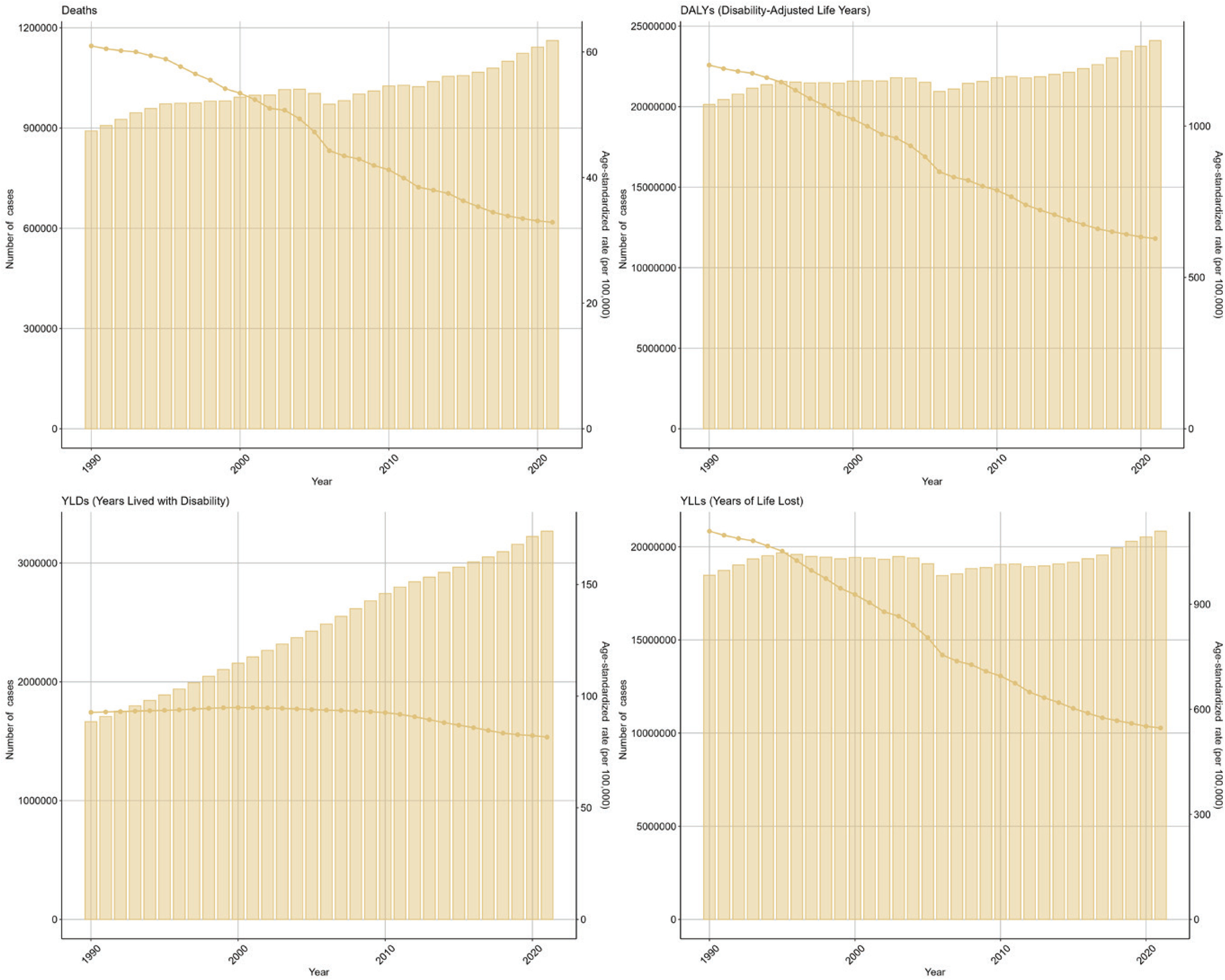
From 1990 to 2021, the number of DALYs, YLDs, YLLs and death of COPD patients aged >40 years caused by smoking increased. In 2021, deaths among COPD patients aged >40 years caused by smoking was 1161716 (95% UI: 904882–1406961) up from 891442 (95% UI: 737503–1049309) in 1990, but the age-standardized mortality rate per 100000 population decreased from 60.96 (95% UI: 50.06–71.73) in 1990 to 32.88 (95% UI: 25.36–39.76), with an EAPC of -1.45 (95% CI: -2.01 – -0.88). The trends of DALYs and YLLs among COPD patients caused by smoking were similar. The number of DALYs increased from 20139236 (95% UI: 16814563–23767923) in 1990 to 24103410 (95% UI: 18915060–28682355), while the age-standardized DALYs decreased from 1201.24 (95% UI: 999.26–1417.38) in 1990 to 628.28 (95% UI: 491.53–749.11) in 2021, the EAPC was -1.62 (95% CI: -2.04 – -1.2) (Figure 1). The number of YLLs increased from 18474625 (95% UI: 15271758–21768195) in 1990 to 20835470 (95% UI: 16341419–25079645), while the age-standardized YLLs decreased from 1108.51 (95% UI: 918.78–1307.56) in 1990 to 546.64 (95% UI: 427.52–658.17) in 2021, the EAPC was -1.84 (95% CI: -2.27 – -1.41). ASR of DALYs, YLLs and death dropped around 50% from 1990 to 2021. But the change of YLDs was different from those of DALYs, YLLs and mortality rates. Its total number rose fastest among the four indicators, nearly doubled over the past three decades, from 1664611 (95% UI: 1281462–2051424) in 1990 to 3267941 (95% UI: 2474613–4104483) in 2021. The ASR of YLDs was steady between 1990 and 2010 and only began to decline slowly in the recent years (92.73; 95% UI: 71.25–114.3) in 1990 versus 81.63 (95% UI: 62.2–102.03) in 2021), with an EAPC of 0.27 (95% CI: -0.07–0.62), suggesting that improvements in standards of living and quality of life need to be strengthened for COPD patients aged >40 years (Figure 1).
Figure 1
Global trends in the absolute number and age-standardized rates (ASRs) of deaths, disability-adjusted life years (DALYs), years lived with disability (YLDs), and years of life lost (YLLs) attributable to smoking-related chronic obstructive pulmonary disease (COPD) among men aged >40 years, based on estimates from the Global Burden of Disease (GBD) 2021 Study, 1990–2021
Burden by regions
Among the five SDI quintiles, the middle SDI region witnessed the largest number of deaths (449737; 95% UI: 336208–554134) of COPD in 2021, followed by low-middle SDI region (295280; 95% UI: 229595–358414). Death cases in the high-middle SDI region were almost the same 245624 (95% UI: 201803–290757) in 1990 and 249280 (95% UI: 187569–308272) in 2021. The high SDI region recorded 113998 (95% UI: 87641–141262) deaths in 2021. But the death numbers in the low SDI region rosed the fastest by more than 61% from 32863 (95% UI: 21595–42019) in 1990 to 52915 (95% UI: 37759–67954) in 2021. The age-standardized mortality rate (ASMR) showed a different trend. ASMR in the low SDI region decreased from 39.05 (95% UI: 26.13–50.21) in 1990 to 29.24 (95% UI: 20.9–37.42) in 2021, with an EAPC of -0.83 (95% CI: -0.95 – -0.71). In 1990, ASMR in middle SDI regions was 97.17 (95% UI: 80.24–114.6), the highest among five quintiles. Low-middle SDI region ranked second (66.38; 95% UI: 48.23–81.74). But in 2021, the position was swapped. The low-middle SDI region had the largest ASMR (53.37; 95% UI: 41.44–65.26), followed by the middle SDI region (45.91; 95% UI: 34.48–56.6). In the last three decades, the sharpest reduction of ASMR occurred in the high-middle SDI quintile (EAPC= -3.15; 95% CI: -3.36 – -2.94), and the smallest change occurred in countries in the low-middle SDI quintiles (EAPC = -0.62; 95% CI: -0.72–0.52) (Supplementary file Figure S1).
Only in high-middle SDI region, both the number and ASR of DALYs and YLLs decreased in 2021 compared to those of 1990. The number of DALYs and YLLs in high-middle SDI region decreased from 5321751 (95% UI: 4412528–6274400) in 1990 to 4809788 (95% UI: 3791430–5862037) in 2021, from 4981244 (95% UI: 4137899– 5912919) to 4117722 (95% UI: 3120719–5057615). ASR of DALYs in high-middle SDI region decreased from 1386.87 (95% UI: 1144.11–1631.36) to 577.68 (95% UI: 450.68–704.82), with an EAPC of -3.31 (95% CI: -3.48 – -3.13), while ASR of YLLs in this region decreased from 1306.88 (95% UI: 1074.95–1547.8) to 499.74 (378–615.26), with an EAPC of -3.62 (95% CI: -3.82 – -3.43) (Supplementary file Figure S1). It is still the low-middle SDI that had the highest age-standardized DALYs (1046.82; 95% UI: 821.49–1270.16) and YLLs (942.8; 95% UI: 731.08–1145.39), with an EAPC of -2.19 (95% CI: -2.24–2.13) and -0.89 (95% CI: -0.97–0.82) separately. The absolute number of middle SDI was the highest in DALYs, 8871355 (95% UI: 6764172–10769032) and YLLs, 7814909 (95% UI: 5861977–9628908). In contrast, high SDI regions exhibited the lowest DALYs, age-standardized DALYs rate and age-standardized YLLs rate: 2593807 (95% UI: 2022137–3134503), 268.81 (95% UI: 210.22–324.77), and 198.24 (95% UI: 154.33–241.6), respectively. The low SDI region showed the lowest YLLs (1097223; 95% UI: 780892–1415319) (Supplementary file Figure S2).
The total number of YLDs among five regions all increased. For the middle SDI region it was the highest (1056446; 95% UI: 800826–1334637). ASR of YLDs was the highest in low-middle SDI region (104.03; 95% UI: 77.73–134.04). High SDI region declined the most significantly, with an EAPC of -0.74 (95% CI: -0.85–0.62). The ASR of YLDs in the high SDI region dropped from 89.65 (95% UI: 68.43–110.95) in 1990 to 70.57 (95% UI: 52.55–89.86) in 2021 (Supplementary file Figure S2).
The ASR for deaths was 69.12 (95% UI: 50.71–86.56), YLDs (118.39; 95% UI: 86.73–155.7), YLLs (995.36; 95% UI: 742.15–1238.64), and DALYs (1099.14; 95% UI: 836.42–1353.9) were the largest in South Asia in 2021. Middle East and North Africa rosed the fastest in ASR of YLDs (68.2; 95% UI: 50.26–87.43), with an EAPC of 1.09 (95% CI: 0.31–1.88). Australasia dropped the quickest in YLDs, with an EAPC of -1.83 (95% CI: -2.24 – -1.42), while Eastern Europe controlled best in terms of ASR of deaths (EAPC= -3.9; 95% CI: -4.24 – -3.55) and YLLs (EAPC= -4.03; 95% CI: -4.41 – -3.65), DALYs (EAPC= -3.69; 95% CI: -4.05 – -3.33) (Supplementary file Figure S3).
Burden by countries and territories
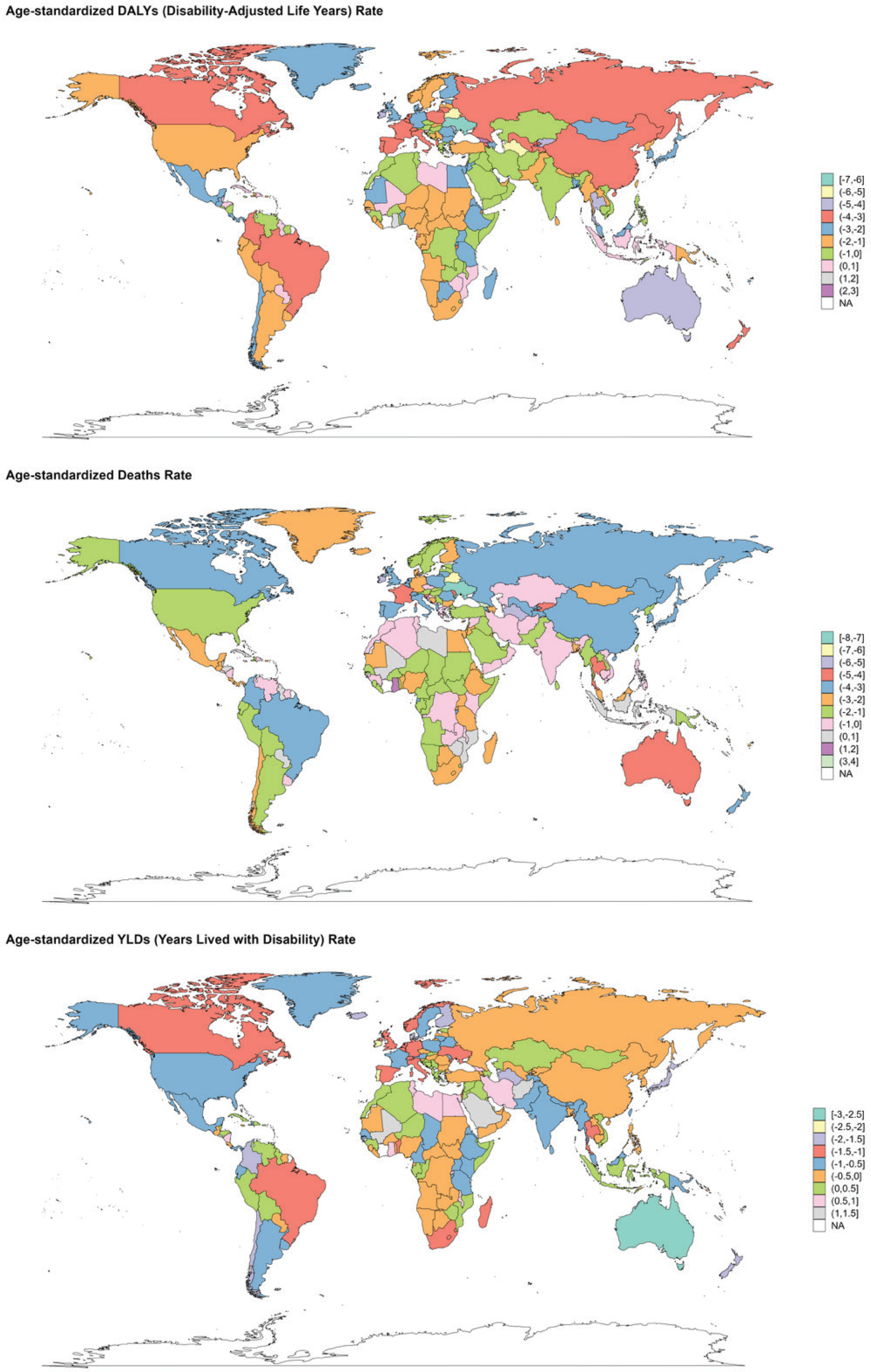
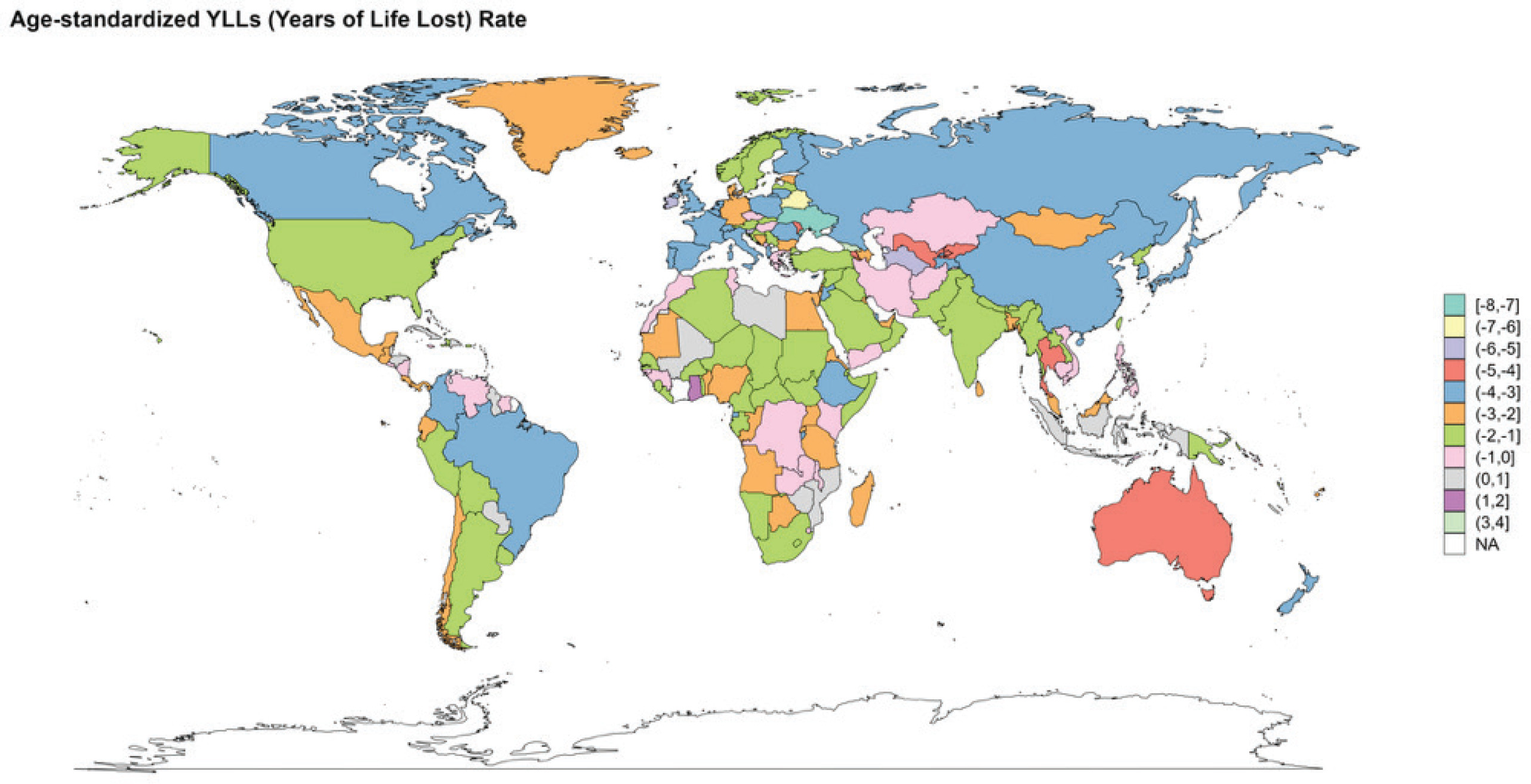
Some countries and territories controlled the ASR of deaths, DALYs, YLDs and YLLs well, while others did not. In 2021, Ukraine did the best in controlling the ASR of deaths, DALYs and YLLs. The total number of deaths in Ukraine was 2900 (95% UI: 1874–4092) in 2021, down from 13183 (95% UI: 11116–15247) in 1990, an ASR of which was 10.45 (95% UI: 6.89–14.61) in 2021 compared to 60.9 (95% UI: 50.55–70.27) in 1990, with an EAPC of -6.49 (95% CI: -6.96 – -6.01). An ASR of DALYs in Ukraine was 252.59 (95% UI: 168.15–349.73) in 2021 compared to 1241.78 (95% UI: 1051.94–1434.69) in 1990, with an EAPC of -6.11 (95% CI: -6.62 – -5.6). The ASR of YLLs in Ukraine was 216.06 (95% UI: 137.85–311.41), while in 1990 ASR of YLLs was 1191.18 (95% UI: 1006.14–1374.22) and EAPC= -6.54 (95% CI: -7.08 – -6.01). In terms of ASR of YLDs, Australia did best. In 2021, ASR of YLDs was 20.5 (95% UI: 13.92–28.37, compared to 45.38 (95% UI: 32.37–60.77) in 1990, with an EAPC of -2.01 (95% CI: -2.43 – -1.58). The ASR of deaths in Democratic People’s Republic of Korea was the highest (82.27; 95% UI: 59.54–105.58), followed by Myanmar (81.16; 95% UI: 63.04–104.35) and Nepal (79.17; 95% UI: 55.93–103.71) in 2021. While in 1990, China ranked first in ASR of deaths (193.55; 95% UI: 157.86–230.03), followed by Democratic People’s Republic of Korea (129.09; 95% UI: 94.4–168.97) and Myanmar (122.93; 95% UI: 91.88–157.4). ASR of DALYs was the highest in Democratic People’s Republic of Korea (1503.68; 95% UI: 1124.82–1885.61), Nepal (1465.22; 95% UI: 1021.99–1901.13) and Myanmar (1427.84; 95% UI: 1090.16–1835.04). ASR of YLDs in Philippines (130.09; 95% UI: 96.86–167.54) and Nepal (130.09; 95% UI: 91.58–166.06) was the topmost. The highest ASR of YLLs was found in Democratic People’s Republic of Korea (1398.25; 95% UI: 1019.17–1773.64) (Figure 2; and Supplementary file Tables 1–4).
Figure 2
Geographical variation in the estimated annual percentage change (EAPC) of age-standardized rates of deaths, disability-adjusted life years (DALYs), years lived with disability (YLDs), and years of life lost (YLLs) for smoking-attributable chronic obstructive pulmonary disease (COPD) among men aged >40 years, by country and territory, 1990–2021. Countries with more negative EAPC values indicate greater declines in burden, whereas positive values suggest increasing trends
COPD burden by age
Considering different age groups, deaths mainly occurred between the age of 75–79 years. The total number of deaths among those aged 75–79 years was 208202 (95% UI: 163696–251018) in 2021. Age-standardized DALYs, YLLs and death rates generally increased with age, but when patients were aged >95 years, these rates began to decline. Age-specific death, DALYs and YLLs peaked at 90–94 years: age-specific rate of deaths 1240.53 (95% UI: 940.84–1530.94), DALYs 11558.45 (95% UI: 8857.4–14132.89), and YLLs 10716.55 (95% UI: 8127.91–13226.18). But the age-standardized YLDs reached the zenith when COPD patients were older than 95 years (862.46; 95% UI: 610.33–1168.51) (Supplementary file Figure S4). Age-standardized YLDs of all age groups declined less than those of age-standardized DALYs, YLLs and death rates from 1990 to 2021. Males aged 40–44 years controlled best in age-standardized DALYs, YLLs, YLDs and death rates [EAPC= -2.82 (95% CI: -2.92 – -2.71); -3.43 (95% CI: -3.56 – -3.29); -0.92 (95% CI: -1.04 – -0.79); -3.42 (95% CI: -3.56 – -3.29] (Supplementary file Figure S5).
Future forecasts of the global burden of COPD patients aged over 40 years caused by smoking
From 2022 to 2050, age-standardized DALYs, YLLs, YLDs, and death rates are projected to show declining trends under both prediction models (Figure 3). Using the ARIMA model (Figure 3), the ASR of deaths is expected to decrease from 32.22 in 2022 to 7.19 in 2050. The ASR of DALYs is projected to decline from 617.01 to 125.82. Similarly, the ASR of YLLs is projected to decrease from 536.07 to 56.26, while the ASR of YLDs is expected to decline from 80.36 to 50.72.
Figure 3
Projected trends of age-standardized rates (ASRs) of deaths, disability-adjusted life years (DALYs), years lived with disability (YLDs), and years of life lost (YLLs) for smoking-attributable chronic obstructive pulmonary disease (COPD) among men aged >40 years from 2022 to 2050, using the Auto‑Regressive Integrated Moving Average (ARIMA) model (upper panel) and the Bayesian age‑period‑cohort (BAPC) model (lower panel). Both models predict continued declines, though the projected reductions differ substantially between the two approaches
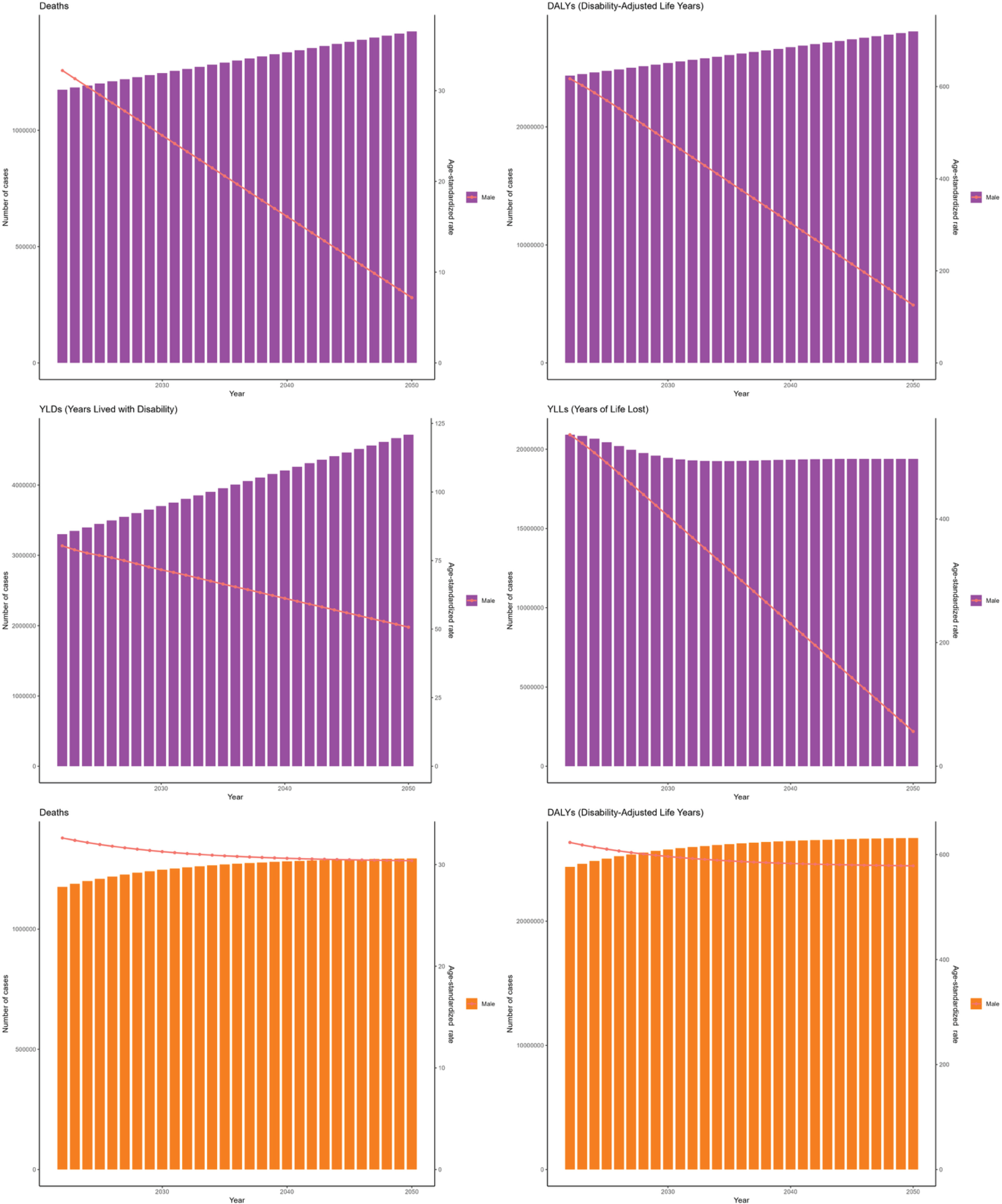
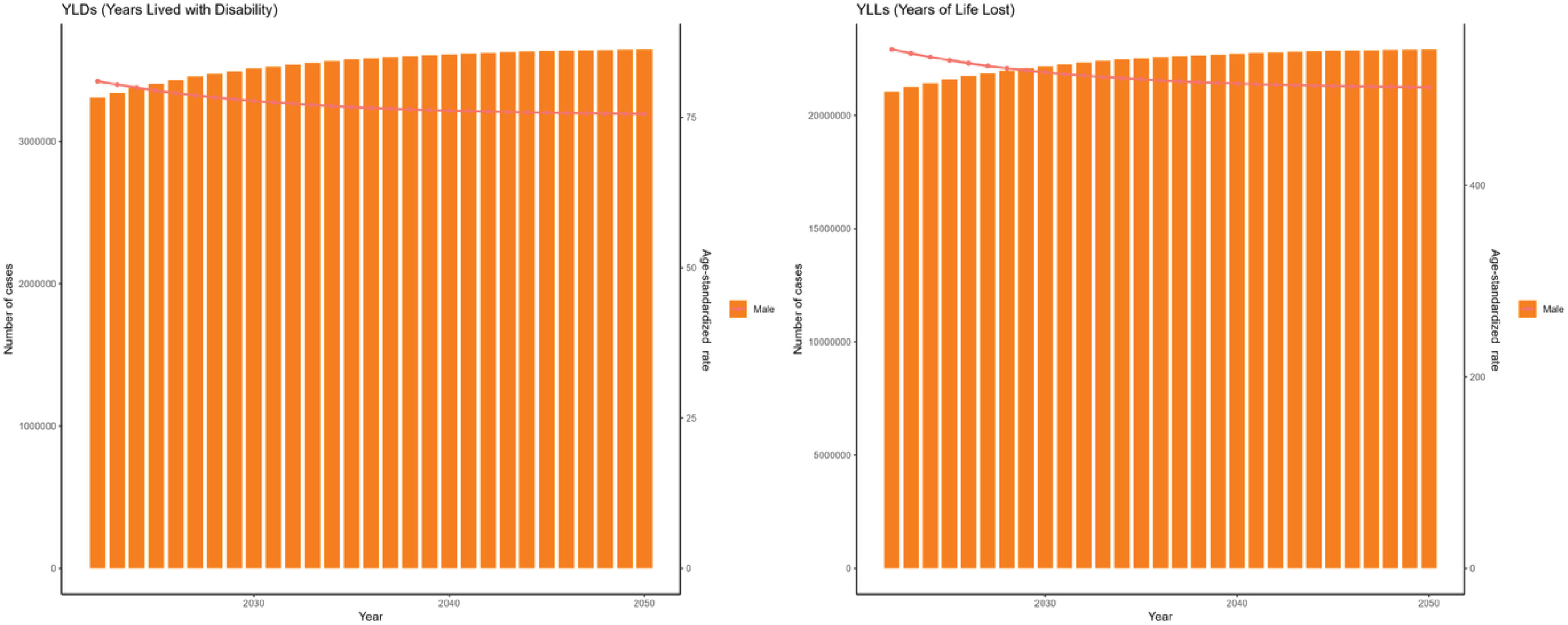
Using the BAPC model (Figure 3), the ASR of deaths is projected to decrease from 32.62 in 2022 to 30.39 in 2050. The ASR of DALYs is expected to decline from 623.05 to 578.49. The ASR of YLLs is projected to decrease from 541.99 to 502.26 , while the ASR of YLDs is expected to decrease from 81.00 to 75.55.
Overall, although the age-standardized DALYs, YLLs, YLDs, and mortality rates are projected to decline by 2050, the remaining burden of smoking-attributable COPD among males aged >40 years will continue to represent a substantial public health challenge.
DISCUSSION
In this study, we systematically assessed the global burden and temporal trends of smoking-attributable COPD among males aged >40 years using the GBD 2021 database from 1990 to 2021. We found that, although the ASRs of deaths, disability-adjusted life years (DALYs), years of life lost (YLLs), and years lived with disability (YLDs) declined globally during the study period, the absolute number of disease burden remained substantial, reflecting the persistent impact of smoking-related COPD. The burden varied considerably across socioeconomic and geographical settings. Low-middle SDI regions exhibited the highest age-standardized mortality, DALY, and YLL rates in 2021, whereas middle SDI regions accounted for the largest absolute number of deaths, DALYs, and YLLs. South Asia had the highest age-standardized burden among geographical regions, while several low SDI and low-middle SDI regions experienced slower declines in burden indicators. Future projections based on ARIMA and BAPC models suggested that the age-standardized burden would continue to decrease through 2050; however, smoking-attributable COPD will remain an important public health challenge among males aged >40 years.
Prevention and control of the disease burden of COPD based on modifiable risk factors is necessary and significant. But the contributions of multiple risk factors differ. According to the data of GBD 2019, smoking remains the most important risk factor for males across all regions16. Previous studies based on the Global Burden of Disease (GBD) study have primarily focused on the overall global burden, temporal trends, and epidemiological patterns of COPD across populations1. However, the specific burden of smoking-attributable COPD among males aged >40 years, particularly considering socioeconomic disparities and future trends, has not been comprehensively characterized. Therefore, our study provides a detailed assessment of this high-risk population by integrating global, regional, and national analyses with future burden projections using the GBD 2021 database. From 1990 to 2021, the ASRs of DALYs, YLLs, YLDs and death all showed a declining trend globally. But efforts to decrease the age-standardized YLDs rate attributable to smoking have not been as effective as those to decrease the age-standardized DALYs, YLLs and death rate. Also, the peak age of the age-standardized YLDs rate occurred later than that of the rest three parameters. All these suggested that the society is aging, and highlighted the need to strengthen long-term COPD management and rehabilitation strategies.
Among the five SDI regions, the ASRs of DALY, YLLs, YLDs and death rates of smoking-related COPD were highest in the low-middle SDI region. And EAPCs of the ASRs of DALY, YLLs, YLDs in the low-middle SDI region and low SDI region indicated a slower decline compared to higher SDI regions. The trend of the ASRs of DALYs, YLLs, YLDs and death in the male COPD patients over 40 years old caused by smoking across the five SDI regions was similar to that of male COPD patients in 201916. These reinforced more public health measures and financial support in these regions.
As for regions and countries, South Asia had the highest ASR of deaths, YLDs, YLLs, DALYs in 2021, just like in 2019. Northern Africa rosed the fastest in ASR of YLDs. It was reported that in the Middle East and North Africa (MENA), the prevalence of COPD has been estimated to be around 4% for adults aged over 40 years in the general population17, a value that is expected to rise due to persistently high and increasing smoking rates18,19. In addition, the principal COPD comorbidities are also frequent in this region, with the prevalence of diabetes in the MENA region being one of the highest in the world (11%)19. This may explain the elevated YLD burden in Northern Africa. In contrast, Australasia dropped the quickest in YLDs and Australia was among the top countries in controlling the YLDs. Eastern Europe saw the fastest decrease in ASR of death rate, YLLs, and DALYs. Ukraine did the best in controlling the ASR of deaths, DALYs and YLLs.
Two models of prediction were adopted to predict the future number of male COPD patients over the age of 40 years attributable to smoking. As a common time-series prediction method, the ARIMA model assumes that past values of a variable can be used to predict future values. In addition, the modeling process of the ARIMA model is relatively simple and adaptable20. The ARIMA model has been applied in forecasting the epidemic trend of various diseases including both infectious and chronic non-communicable diseases. For example, the ARIMA model was used to predict the estimated confirmed cases and epidemic trends of COVID-19 from 24 April to 7 July 2020 across the top 15 countries with confirmed cases, deaths, and recoveries from COVID-1921. The accuracy of the ARIMA model was verified by the results which showed that most of the observed actual values were well within 95% confidence interval of the ARIMA model22. In the United States, the ARIMA model was used to predict the incidence of cancer from 2015 to 202023 and global bladder cancer trends from 2017 to 203024. However, ARIMA is limited by its reliance on linear relationships in time series data and its susceptibility to overfitting when incorporating covariates, as it depends heavily on prior values and residuals. To address these shortcomings, Bayesian modeling methods have gained attention in recent years. For instance, the model can incorporate seasonal effects related to social behaviors or public health interventions that traditional ARIMA models may overlook25. But these two methods were never compared in the prediction of COPD. Teng et al.26 compared a generalized additive model (GAM), ARIMA model, and curve-fitting method in predicting COPD in China, and GAM and AIRMA models were recommended.
Strengths and limitations
This study has several strengths. First, we used the latest GBD 2021 dataset to provide a comprehensive assessment of the global burden of smoking-attributable COPD among males aged >40 years over three decades (1990–2021), covering multiple geographical locations and socioeconomic levels. Second, unlike previous studies focusing mainly on overall COPD burden27,28, our study specifically investigated a high-risk population and integrated analyses of temporal trends, socioeconomic disparities, and future projections. Third, the application of complementary prediction approaches (ARIMA and BAPC models) provided additional insights into the potential future trajectory of smoking-attributable COPD burden and may help inform targeted prevention strategies.
Several limitations should be considered when interpreting our findings. First, as with other GBD-based analyses, the estimates are derived from statistical modeling using available epidemiological data, national and regional sources, and published literature rather than complete population-based registries. Therefore, the accuracy of estimates may vary across countries and regions, particularly in areas with limited surveillance systems or insufficient healthcare resources9,16. Second, COPD remains substantially underdiagnosed worldwide, including in some developed countries, and differences in diagnostic capacity, spirometry availability, and disease definitions may introduce measurement bias and affect cross-country comparisons26. Although the GBD framework incorporates multiple modeling procedures, smoothing techniques, and uncertainty estimation, these approaches cannot completely eliminate biases caused by underreporting, misclassification, or incomplete data availability.
Third, because this study used population-level estimates, the observed associations between smoking-attributable COPD burden and socioeconomic or geographical factors should be interpreted cautiously. Ecological fallacy may occur when population-level patterns are incorrectly extrapolated to individuals. Moreover, the observational nature of GBD estimates prevents causal inference regarding the relationship between smoking exposure and COPD outcomes. Finally, although ARIMA and BAPC models were used to project future trends, these projections rely on assumptions regarding historical patterns and may not fully account for future changes in tobacco control policies, smoking behaviors, healthcare accessibility, or other emerging risk factors.
CONCLUSIONS
This study reveals the burden of male COPD patients aged >40 years caused by smoking at the global, regional, and national levels. Although the ASR of male COPD patients aged >40 years caused by smoking has decreased globally, the absolute burden of male COPD patients aged >40 years caused by smoking is still heavy.