


INTRODUCTION
Adherence to inhaled therapies is a critical determinant of clinical outcomes in chronic respiratory diseases, including asthma and chronic obstructive pulmonary disease (COPD)1,2.
Poor adherence results in exacerbations, increased healthcare utilization, and decreased quality of life3. Despite advances in treatment guidelines, measuring adherence in an objective way remains challenging for clinicians, especially in routine practice4-7.
Conceptual models of medication-taking behavior offer a structured way to identify the patient-level factors that drive adherence in chronic respiratory disease. The Theory of Planned Behavior, in particular, has been increasingly applied to inhaler-treated populations and posits that adherence behavior is shaped by three interrelated constructs: attitudes towards the prescribed treatment, perceived subjective norms surrounding chronic disease management, and the patient’s perceived behavioral control over the prescribed regimen8. These determinants can be operationalized in dedicated psychometric instruments9 or captured indirectly through behavioral endpoints in standardized adherence questionnaires, which record the consequences of these upstream beliefs rather than the beliefs themselves.
One such instrument, the Test of Adherence to Inhalers (TAI) is a standardized, validated questionnaire developed to identify and quantify patterns of non-adherence for inhaled medication use in respiratory diseases10,11. Initially designed in Spanish, the TAI has undergone cross-cultural adaptation and validation in multiple languages and settings, including Italian, Persian, Chinese, and Malaysian12-15. These studies have consistently demonstrated robust psychometric properties, confirming the TAI as a reliable tool for both clinical research and routine practice.
To our knowledge, no validated Albanian version is available. A recent global systematic review of inhaler adherence determinants in asthma and COPD included no studies from any Western Balkans country16, and a recent regional review from North Macedonia confirmed the absence of validated measurement methods for asthma medication adherence in the region17. Standardized forward-backward translation, expert review, and pilot testing, as recommended by the COSMIN methodology for the linguistic and cross-cultural adaptation of patient-reported outcome measures18-20, were therefore essential to ensure conceptual equivalence, content validity, and interpretability of the Albanian TAI in local clinical practice. This study aimed to translate, culturally adapt, and validate the Albanian version of the TAI in a consecutive convenience-based sample of patients with COPD and asthma at a single tertiary center. Specifically, our objectives were to assess the reliability and factor structure of the Albanian TAI, determine known-groups validity by disease severity, and establish criterion validity with clinical measures.
We hypothesized that the Albanian TAI would demonstrate a similar factor structure and internal consistency to the original Spanish version, as well as significant score differences based on disease severity (known-groups validity) and clinical markers (criterion validity).
METHODS
Study design and setting
This cross-sectional validation study was conducted at the Tirana Regional Hospital Center ‘Shefqet Ndroqi’, Albania’s national referral center for pulmonary diseases, from March 2024 to March 2025. All study procedures were approved by the Ethics Committee of the University of Medicine, Tirana (approval number 2096/1 Prot., dated 01.08.2024), and written informed consent was obtained from every participant.
Participants
Eligible participants were adult outpatients (≥18 years) with a confirmed diagnosis of asthma or COPD, verified by spirometry and documented in accordance with GOLD (Global Initiative for Chronic Obstructive Lung Disease, 2024) and GINA (Global Initiative for Asthma, 2024) criteria4,5. Only patients who were currently prescribed at least one inhaler and fluent in Albanian were included. Patients with cognitive impairment, inability to consent, or an acute exacerbation in the previous two weeks were excluded.
Study instrument
The TAI is a 12-item self-administered instrument developed by Plaza et al.10 to assess medication adherence in patients with asthma and COPD. The first ten items (Q1–Q10) are completed by the patient and capture adherence behavior, including missed doses, intentional dose reduction, lifestyle interference, and beliefs about treatment necessity. Each item is rated on a 5-point Likert scale (1=worst adherence/all week to 5=best adherence/never), yielding a subscale score from 10 to 50. The remaining two items (Q11–Q12) are clinician-administered and assess inhaler technique and patient knowledge of the prescribed regimen, each rated from 1 to 2 (subscale score 2 to 4). The combined 12-item total ranges from 12 to 54, with established cutoffs of ≥50 indicating high adherence, 46–49 intermediate adherence, and ≤45 low adherence10. The full Albanian version is provided in the Supplementary file.
Following the methodology of the original Spanish validation10 and subsequent cross-cultural adaptations12-15, the present psychometric analyses were performed only on the ten self-report items (Q1–Q10). The clinician-rated items (Q11–Q12) were collected during routine clinical assessment but were not included in reliability or factor analyses, to preserve methodological comparability with previous TAI validation studies.
Translation and cultural adaptation
The TAI-12 was translated into Albanian from the established English version, as English is the working language of the international validation literature12-15 and was the version available to our bilingual translators. Permission for academic use of the TAI was obtained through the BiblioPRO patient-reported outcome measures registry, the authorized distribution platform for the questionnaire21. Forward translation was performed independently by two native Albanian speakers with clinical training (a clinical pharmacist with 15 years of clinical experience and a medical resident, with 5 years of experience), both clinically informed and with prior PROM translation experience. The two forward versions were reconciled by consensus. Back-translation into English was performed independently by a pulmonology resident who was not involved in the forward translation and who was blinded to the original English instrument. The expert panel, comprising the lead author (IA, clinical pharmacist with 4 years of experience in respiratory pharmacotherapy) and a senior pulmonologist (DhA, with 32 years of clinical experience in COPD and asthma management at the national pulmonary referral center), reviewed the reconciled translation for linguistic clarity, semantic equivalence, and cultural relevance. The final draft was pilot-tested for clarity and feasibility with five healthcare professionals from the Tirana Regional Hospital Center ‘Shefqet Ndroqi’ (two senior pulmonologists with more than 20 years of clinical experience, two pulmonology residents in their final year of training, and one respiratory nurse with eight years of clinical experience). Cognitive debriefing within the target patient population was not performed, which is acknowledged as a limitation of the present translation methodology.
Recruitment and data collection
Trained pulmonologists and residents administered the Albanian TAI during routine outpatient visits. Demographic and clinical data (age, sex, education level, occupation, years since diagnosis, COPD stage according to GOLD 2024 A–E groups; asthma control as mild, moderate, or severe based on the GINA 2024 treatment steps required to achieve control, FEV1 %, number of prescribed inhalers) were collected via patient interview and medical record review. Data were entered into a secure, anonymized electronic database.
Statistical analysis
Continuous variables are summarized as mean and standard deviation (or median and range where distributions deviated from normality), and categorical variables as frequencies and percentages. Internal consistency was estimated using Cronbach’s alpha and item-rest correlations. Because this represents the first validation of the TAI in the Albanian cultural context, we used exploratory factor analysis (EFA) rather than confirmatory factor analysis to allow the underlying factor structure to emerge without imposing a pre-specified model. Suitability of the data for factor analysis was assessed using the Kaiser–Meyer–Olkin (KMO) measure of sampling adequacy and Bartlett’s test of sphericity. Structural validity was evaluated through principal axis factor analysis with oblimin rotation, retaining factors with eigenvalues >1, and examining the scree plot for dimensionality.
Known-groups validity was assessed by comparing TAI scores across COPD and asthma severity categories using Welch’s ANOVA with Games–Howell post hoc tests, given violation of the homogeneity-of-variance assumption.
Criterion validity was assessed by correlating TAI scores with FEV1 % predicted, calculated using the Global Lung Function Initiative (GLI) 2012 equations, and with the number of prescribed inhalers, using Pearson’s r. Analyses were performed using Jamovi (version 2.7.12) together with R (version 4.5) and the psych package22-24. A two-sided p<0.05 was considered statistically significant.
RESULTS
Participant characteristics
A total of 326 patients participated, with a range of COPD and asthma severity represented in the sample. Mean age was 66.6 years (SD=11.9), 240 (73.6%) were male, and the sample was approximately evenly distributed between urban (n=170; 52.1%) and rural (n=156; 47.9%) residence. Most patients had completed secondary school (n=222; 68.1%), with smaller proportions in primary or 9-year schooling (n=66; 20.2%), university (n=30; 9.2%), or no formal schooling (n=8; 2.5%), reflecting national trends of education level in Albania25. Mean FEV1 was 57.7 ± 20.5% predicted. The sample comprised 210 patients with COPD (64.4%; GOLD Group A, n=15; Group B, n=81; Group E, n=114) and 116 with asthma (35.6%; mild, n=38; moderate, n=43; severe, n=35). Patients were prescribed one (n=42; 12.9%), two (n=156; 47.9%), or three (n=128; 39.3%) inhalers. Full sociodemographic and clinical characteristics are presented in Table 1.
Table 1
Sociodemographic and clinical characteristics of adults with asthma and COPD attending a tertiary pulmonary referral center in Tirana, Albania, March 2024–March 2025 (N=326)
TAI item characteristics
All ten TAI self-report items were completed by every participant, with no missing data. Item means ranged from 2.7 to 4.2, indicating adequate variability and absence of floor or ceiling effects. Table 2 summarizes item-level metrics, including mean, SD, skewness, and kurtosis, demonstrating distributions suitable for psychometric analysis.
Table 2
Item-level descriptive statistics for the Albanian version of the Test of Adherence to Inhalers (TAI), cross-sectional validation study, Tirana, Albania, March 2024–March 2025 (N=326)
Cronbach’s alpha for the 10-item scale was 0.64. Item-rest correlations were highest for items 1 to 3 (r=0.507, 0.679, and 0.554, respectively) and lowest for items 5, 6, and 8 (r=0.009, 0.056, and 0.140, respectively) (Table 3).
Table 3
Item-level psychometric statistics for the Albanian version of the Test of Adherence to Inhalers (TAI), cross-sectional validation study, Tirana, Albania, March 2024–March 2025 (N=326)
| Items | Item-rest correlation | Factor loading | Uniqueness |
|---|---|---|---|
| TAI 1 | 0.507 | 0.766 | 0.413 |
| TAI 2 | 0.679 | 0.851 | 0.276 |
| TAI 3 | 0.554 | 0.692 | 0.521 |
| TAI 4 | 0.235 | 0.322 | 0.896 |
| TAI 5 | 0.009 | * | 1.000 |
| TAI 6 | 0.056 | * | 0.987 |
| TAI 7 | 0.414 | 0.422 | 0.822 |
| TAI 8 | 0.140 | * | 0.983 |
| TAI 9 | 0.320 | 0.382 | 0.854 |
| TAI 10 | 0.241 | * | 0.948 |
Exploratory factor analysis supported a unidimensional structure: Factor 1 (eigenvalue 2.30) accounted for 23 % of total variance. Items 1–3 exhibited the highest loadings, while items 5–10 showed low loadings and high uniqueness (Table 3). The Kaiser–Meyer–Olkin statistic was 0.74, with Bartlett’s test confirming suitability for factor analysis (χ2=587, p<0.001).
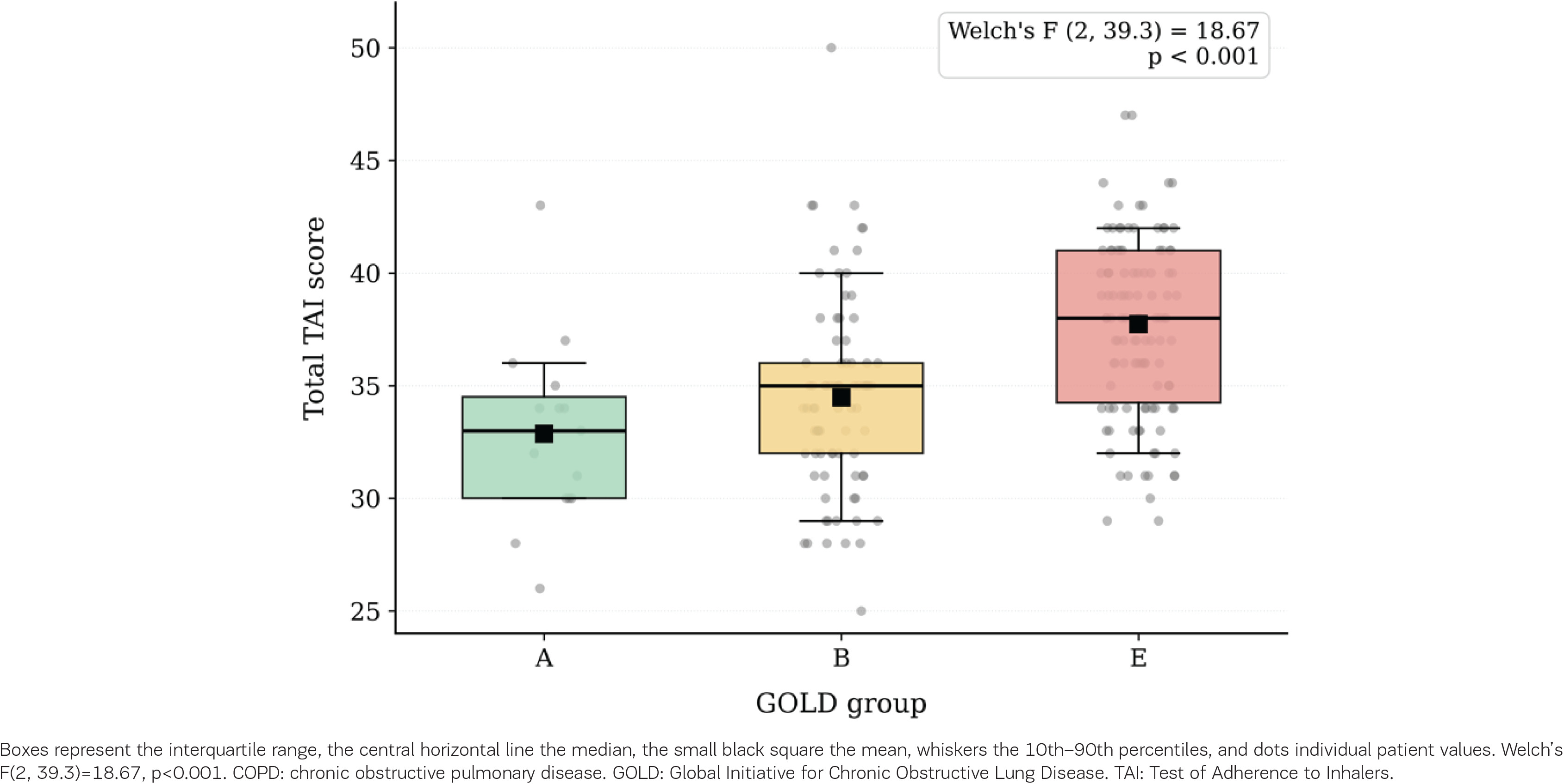
Regarding known-groups validity, TAI total scores differed significantly across COPD stages (Welch’s F=18.7, p<0.001). Patients with advanced COPD (stage E) reported the highest average adherence (mean=37.7, SD=4.18), followed by those at moderate (mean=34.5, SD=4.33) and early stages (mean=32.9, SD=4.12) (Figure 1).
Figure 1
Total TAI score by GOLD A–E group in adults with COPD, cross-sectional validation study, Tirana, Albania, March 2024–March 2025 (N=210)
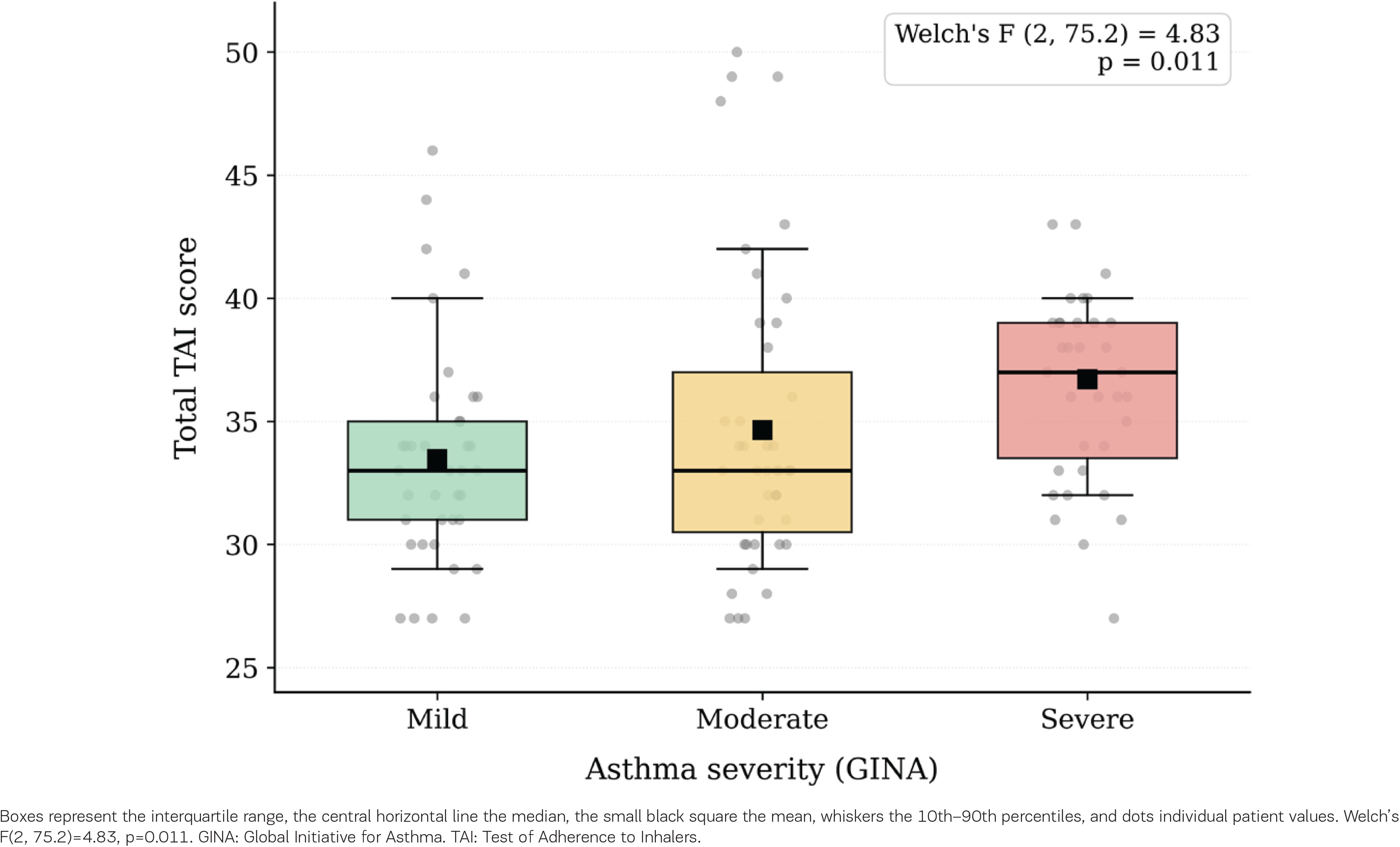
Similarly, TAI total scores differed significantly across asthma severity groups (Welch’s F=4.83, p=0.011). Post hoc comparisons using the Games-Howell test revealed that patients with severe asthma reported significantly higher adherence (mean=36.7, SD=4.42) compared to those with mild asthma (mean=33.5, SD=4.52, p=0.008). No significant differences were found between moderate asthma (mean=34.7, SD=6.08) and the other stages (Figure 2).
Figure 2
Total TAI score by GINA severity category in adults with asthma, cross-sectional validation study, Tirana, Albania, March 2024–March 2025 (N=116)
Correlation analyses revealed an inverse association between TAI score and FEV1 % predicted (r= -0.298, p<0.001) and a positive correlation with the number of inhalers prescribed (r=0.209, p<0.001).
DISCUSSION
To our knowledge, this study presents the first linguistic and psychometric evaluation of the TAI in Albanian. High completion rates and adequate item-level dispersion indicate the instrument’s acceptability and feasibility in Albanian respiratory clinics.
Our hypothesis was partially rejected. While the tool successfully differentiated patient groups (confirming criterion validity), it did not meet the expected threshold for internal consistency (>0.80) seen in the original Spanish, Italian, Persian, and Malaysian validations (0.85–0.90)10,12-15. As in Malaysian and Persian studies, items assessing inhaler technique errors, symptom-driven, or lifestyle-dependent behaviors performed less well. Specifically, Item 5 (work interference) showed high uniqueness, indicating that most patients reported minimal work interference. This likely reflects the demographic profile of the cohort (mean age 66.6 years, with 86.2% in farming or manual labor). Item 6 (fear of side effects) and Item 8 (intentional dose reduction) similarly contributed weakly to the overall scale, with low item-rest correlations indicating limited contribution to the construct measured by the scale. Item 4 (holidays/weekends) performed poorly because concepts of distinct ‘weekends’ or ‘holiday’ routines may differ in this predominantly elderly, rural Albanian population compared to Western European study samples. These items limited the tool’s ability to discriminate adherence behaviors, contributing to the observed low loadings and poor KMO values26.
Despite lower internal consistency and item-level variability, the TAI showed meaningful clinical validity. Higher adherence among patients with severe COPD and asthma has also been documented in international study samples, suggesting that severity-related engagement strengthens adherence behaviours10,15,27. Correlations with FEV1 % and regimen complexity show patterns consistent with real-world adherence dynamics. This suggests a ‘severity-adherence’ pattern where the clinical burden of advanced disease, whether asthma or COPD, serves as a primary driver for medication compliance. These findings support the scale’s utility in capturing overall adherence patterns, but caution is advised in interpreting items with weaker psychometric performance. A culturally adapted revision may improve reliability and factor structure.
Limitations
The present study has several limitations. Recruitment was conducted at a single tertiary referral center using consecutive convenience-based sampling, which may have introduced selection bias toward more complex diseases and may limit generalizability to primary care or non-specialist settings in Albania. Internal consistency was modest, and limited variance was explained by the single extracted factor, with several items contributing weakly. Cognitive debriefing within the target patient population was not performed; pilot testing was limited to healthcare professionals, which may have affected items addressing culturally loaded concepts.
CONCLUSIONS
The Albanian TAI demonstrated acceptable clinical utility, distinguishing patients by disease severity in both COPD and asthma populations and correlating with established clinical markers (FEV1 and number of prescribed inhalers). Psychometric performance was modest, with items 5, 6, and 8 contributing weakly to the overall scale structure. Item 5 (work interference) is likely to require cultural adaptation, as the concept may have limited applicability in a predominantly older, rural, and non-salaried Albanian population. Item 6 (fear of side effects) may require linguistic refinement to better capture the medication concerns relevant to this study population. Item 8 (intentional dose reduction) shows adequate response variability but limited correlation with the underlying construct and may require psychometric re-anchoring or structural review. The scale is suitable for clinical screening in its current form, with larger multi-center validation samples needed to confirm performance after item revision.