


INTRODUCTION
Vaccine-preventable diseases (VPDs) represent a substantial and persistent burden among adults, particularly in patients with chronic respiratory diseases (CRDs) such as chronic obstructive pulmonary disease (COPD), asthma, and interstitial lung diseases (ILDs). For these patients, VPDs may trigger acute exacerbations, worsen disease progression, reduce quality of life, and increase hospitalization and mortality. The cumulative clinical burden is further amplified by aging and the presence of multiple comorbidities, positioning patients with CRDs as a priority group for targeted immunization strategies1,2.
Vaccination is a core preventive strategy to address this issue, yet adult vaccination coverage often remains suboptimal and uneven across recommended vaccines3-5. This gap reflects limited awareness and perceived susceptibility, concerns about vaccine safety and effectiveness, misinformation and mistrust, inadequate healthcare provider recommendation, access-related barriers, and missed opportunities during routine care, preventing evidence-based recommendations from being consistently translated into individualized, patient-centered preventive action in primary care3,5. Addressing this gap is important because adult immunization programs can generate important health benefits while demonstrating favorable cost-effectiveness and positive socioeconomic returns6,7.
Community pharmacists are well positioned within primary care as highly accessible healthcare professionals in the community, with frequent contact with adults living with chronic conditions and an established contribution to preventive care8. From a pharmaceutical care perspective, pharmacists contribute to patient care by optimizing medicine use and improving health outcomes. Applied to adult immunization, this contribution extends beyond vaccine administration and may include patient identification, vaccination-status assessment, eligibility and contraindication screening, individualized evidence-based counselling, response to concerns and misinformation, reminder systems, referral or appointment scheduling, documentation, and follow-up. When implemented among older adults and patients with chronic diseases such as CRDs, these pharmacist-led activities have been shown to improve vaccination uptake and access to preventive care9,10. Moreover, their contribution is strengthened when these activities are embedded within coordinated interprofessional primary care pathways that support shared responsibility, communication, and continuity of care11-14.
European and international professional frameworks support the expansion of pharmacy-based vaccination services and emphasize the policy, organizational, and competency requirements for their safe integration into healthcare systems8,15,16. In Greece, certified community pharmacists are legally authorized to administer vaccines included in the National Adult Immunization Program, subject to defined clinical exceptions, under Law 5102/2024, Article 47(1) (Government Gazette A' 55, 13 April 2024). More recently, the e-Government Center for Health and Social Security Single Member S.A. (IDIKA S.A., https://www.idika.gr/) activated pharmacists’ access to the National Adult Vaccination Registry, enabling them to review patients’ vaccination histories and document vaccinations administered in community pharmacies17.
These developments improve the capacity for vaccination documentation and create conditions for more integrated pharmacist participation in preventive care. However, the main implementation challenge is to translate this expanded capacity into structured, evidence-based primary care pathways that define responsibilities, support interprofessional coordination, and align pharmacy-based vaccination activities with physician-led care18,19. This issue is also relevant to healthcare systems with comparable primary care and community pharmacy structures, where guideline recommendations must be operationalized into consistent, documented, and continuous adult immunization pathways.
Building on the considerations outlined above, this work aims to synthesize implementation-oriented evidence on adult immunization in patients with CRDs and translate it into a pharmacy practice perspective. Through a structured narrative review, it presents vaccination priorities, barriers to uptake, pharmacist-led interventions, and interprofessional care requirements relevant to routine pharmacy encounters for this patient group. By summarizing available guidelines and evidence through the prism of pharmaceutical care, it outlines a practice-oriented framework for community pharmacists to support vaccination-status assessment, patient counselling, documentation, referral, and follow-up within physician-led primary care pathways. Informed by the Greek primary care ecosystem, the review aims to show how guideline-based vaccination recommendations can be operationalized into structured pharmaceutical care activities to optimize adult immunization in patients with CRDs, with potential relevance to comparable healthcare systems.
A structured narrative review was conducted to synthesize evidence on adult vaccination in patients with CRDs, with emphasis on implementation strategies and the role of community pharmacists in primary care. Targeted literature searches were performed in PubMed/MEDLINE, Scopus, and Web of Science for English-language publications from January 2015 to June 2026. This period was selected to capture approximately the most recent decade of evidence and contemporary developments in adult immunization recommendations, pharmacy practice, and primary care delivery. Search terms combined concepts related to adult vaccination, chronic respiratory disease, COPD, asthma, ILD, vaccine uptake, vaccine hesitancy, community pharmacy, pharmacist-led interventions, pharmaceutical care, interprofessional collaboration, and immunization programs. Searches were complemented by relevant guideline, policy, and practice documents from national and international organizations, including WHO, ECDC, the Hellenic Ministry of Health, the Hellenic Thoracic Society, and other scientific or professional bodies.
The literature searches and initial identification of potentially relevant sources were conducted by CV and AF. The identified literature was subsequently reviewed and synthesized by MS and EV, who prioritized sources according to their direct relevance to the review objectives, recency, and, for recommendations and policy, the authority of the issuing organization. Where several publications addressed the same question, contemporary systematic reviews, meta-analyses, and current national or international guidance were preferentially used. Additional references were identified through citation searching for key publications and organizational documents. The search was intended to identify key contemporary evidence for a structured narrative synthesis rather than to provide exhaustive systematic retrieval of all available studies.
Findings were synthesized narratively and organized around vaccination priorities, implementation barriers, pharmacist-supported interventions, patient communication, interprofessional care, and practical considerations for integrating community pharmacists into adult immunization pathways within the Greek primary healthcare context. Following the narrative synthesis, the proposed framework was informed by recurrent implementation functions identified across national adult immunization guidelines, international recommendations, systematic reviews, and pharmacy-practice evidence, and was refined for routine community-pharmacy encounters through discussion among the multidisciplinary author team. The reporting and presentation of the review were guided by the Scale for the Assessment of Narrative Review Articles (SANRA)20 (Supplementary file).
DEVELOPMENTS
Current vaccination priorities in chronic respiratory diseases
Adult immunization programs combine age-based and risk-based recommendations endorsed by national and international scientific bodies, with patients with CRDs consistently included among priority groups2,21-23. Vaccination strategies therefore address both high-impact respiratory pathogens and other VPDs that may contribute to morbidity, complications, or clinical destabilization.
Across Europe, recommendations focus on prioritizing patients with CRDs, although implementation strategies, reimbursement conditions, schedules, and delivery pathways may vary24. In Greece, the National Adult Immunization Program (NAIP), issued by the National Vaccination Committee (NVC), includes a broad range of vaccines considered clinically relevant for patients with CRDs because of their association with exacerbations, hospitalization, and severe outcomes2,21,25,26. Scientific societies, such as the Spanish Society of Pulmonology and Thoracic Surgery (SEPAR), strongly advocate a comprehensive vaccination approach in patients with CRDs, extending beyond core respiratory vaccines to include pertussis and herpes zoster2. Scientific societies in Italy also emphasize the importance of implementing focused immunization strategies to reduce complications, decrease healthcare expenditures, and improve the overall quality of life for individuals with respiratory conditions23. At the global level, pertussis remains a public health problem despite established pediatric vaccination programs, while vaccination coverage among adults remains suboptimal and the disease burden has increasingly shifted towards adolescents and adults, including vulnerable populations with chronic conditions such as patients with COPD27. Recent developments in adult pneumococcal vaccination include the 21-valent pneumococcal conjugate vaccine (PCV21), which broadens the available higher valency conjugate vaccine options28. Although the evidence base varies across vaccines and respiratory conditions, current recommendations consistently support risk-based vaccination in adults with CRDs. Evidence for influenza and pneumococcal vaccination is well established, whereas recommendations for COVID-19 and RSV continue to evolve with epidemiology and emerging evidence. Tdap and RZV are mainly incorporated within broader age- and risk-based adult immunization strategies. In practice, vaccine prioritization should therefore follow national guidance while considering respiratory diagnosis and severity, age, smoking status, comorbidities, immunosuppression, and previous vaccination history1,2,22,23,26. From a pharmacy practice perspective and considering the expanding role of pharmacists within the primary care ecosystem, clear and practical guidance is essential during pharmacy encounters.
Table 1 summarizes practice-oriented vaccine considerations for adults with CRDs, based on current immunization recommendations, regulatory guidance, and relevant product information, and highlights how pharmacists can support patients and collaborate with other healthcare professionals to implement vaccination recommendations. These vaccination priorities define the scientific content that pharmacists need to recognize during routine pharmacy encounters; however, their impact depends on whether eligible patients are systematically identified, informed, referred, vaccinated, documented, and followed up.
Table 1
Practice-oriented adult vaccine priorities, clinical recommendations, and pharmacist-supported assessment, medication review, and referral considerations for adults with CRDs in the Greek primary care contexta, based on national and international guidance current to June 2026
| Clinical relevance and key recommendation | Pharmacist assessment, continuity and co-administration | Medication review and physician referralc |
|---|---|---|
| Influenza | ||
| COVID-19 | ||
| Pneumococcal disease (PCV20, PCV21b) | ||
| RSV | ||
| Tetanus–diphtheria–pertussis (Tdap) | ||
| Herpes Zoster (RZV) | ||
a Greek practice context: Conventional seasonal influenza vaccines may be administered in community pharmacies without prior medical prescription. Certified pharmacists may also administer prescribed vaccines included in the National Adult Immunization Program, subject to defined exceptions.
b PCV21: Recommendations reflect current Greek and international guidance as of June 2026. PCV21 is authorized in the European Union but not included in the current Greek adult immunization guidance available at the time of this review.
c Common medication review: Review systemic corticosteroids, immunosuppressive biologics, chemotherapy, radiotherapy, transplant medicines, anticoagulants, thrombocytopenia and bleeding disorders. Chronic inhaled respiratory therapy generally requires no change in vaccination timing. Refer for physician review when immunosuppressive biologics, chemotherapy, radiotherapy or transplant medicines are prescribed, or in severe immunosuppression, complex comorbidity, uncertain vaccination history, active febrile illness or significant respiratory exacerbation. CRD: chronic respiratory disease. COPD: chronic obstructive pulmonary disease. ILD: interstitial lung disease. ICS: inhaled corticosteroid. LABA: long-acting β2-agonist. LAMA: long-acting muscarinic antagonist. PCV: pneumococcal conjugate vaccine. PPSV: pneumococcal polysaccharide vaccine. RSV: respiratory syncytial virus. RZV: recombinant zoster vaccine. Tdap: tetanus, reduced-diphtheria, and acellular pertussis vaccine.
Vaccination coverage, barriers, and opportunities
During the 2024–2025 season, only a few countries approached or exceeded the 75% influenza vaccination coverage target generally pursued across the EU. According to data from the European Centre for Disease Prevention and Control (ECDC), coverage among older adults was highest in Denmark (76%), Ireland (74.5%), Portugal (70.58%), Sweden (68%), and Norway (66%), whereas substantially lower rates were reported in Poland (5%), Latvia (14.7%), Lithuania (24.10%), Estonia (24.65%), the Czech Republic (26.07%), and Croatia (27%). Among the total adult population aged ≥18 years in EU/EEA countries during the same season, Malta reported the highest coverage at 57.22%, while rates in all other reporting countries were 29% or lower29.
Barriers to vaccination are multifactorial and operate at patient, provider, and system levels. At the patient level, vaccine hesitancy remains a major obstacle, driven by concerns about safety, perceived low effectiveness, misinformation, limited awareness of individual risk, and declining trust in healthcare systems30,31. These challenges intensified after the COVID-19 pandemic, while misinformation through digital media has extended hesitancy beyond COVID-19 vaccines to adult immunization in general32. In patients with CRDs, mobility limitations, multimorbidity, and access difficulties may create additional obstacles, especially among older adults. At the system level, fragmented care, poor provider coordination, and limited proactive identification and follow-up can delay or prevent vaccination33.
In Greece, community pharmacists can dispense and administer adult vaccines prescribed by physicians under the National Immunization Program, while conventional trivalent seasonal influenza vaccines can also be administered to the general population without prior medical prescription. Recent developments have further expanded pharmacists’ access to patients’ electronic vaccination history, allowing vaccination-status records to be reviewed and updated after pharmacy-based vaccination. These developments are relevant because adult vaccination coverage in Greece remains fragmented, with reported uptake of approximately 55% for influenza among high-risk groups, 36% for pneumococcal vaccination, 12% for herpes zoster and 21% for tetanus3. More recent data from a single primary care sample of Greek adults aged ≥60 years, not specifically restricted to patients with CRDs, further indicate fragmented vaccination patterns, with higher uptake for influenza (82.5%), moderate for pneumococcal (68.3%) and herpes zoster (56.0%), and low uptake for tetanus–diphtheria–pertussis booster (13.0%) and RSV (5.2%). Only 10.1% of participants achieved a high vaccination coverage score (VCS ≥66.7%), defined as receipt of at least two-thirds of the vaccines individually recommended for them4. These findings support the need for further strengthening adult immunization within primary care. An operational framework for community pharmacists could guide patient identification, risk-based prioritization, reminders, counselling, documentation, referral pathways, and communication with primary care physicians34,35.
Evidence for pharmacist-led vaccination interventions and implementation opportunities
Evidence from systematic reviews and meta-analyses supports the positive effect of community pharmacist-led interventions on adult vaccination uptake, although effect magnitude varies according to study design, vaccine type, pharmacist role, intervention intensity, and integration into routine care (Table 2). Borlini et al.36 in a meta-analysis of 35 studies involving more than 1.3 million participants, reported increased uptake in pre–post analyses comparing vaccination after versus before pharmacy-based interventions (OR=1.88; 95% CI: 1.68–2.12) and in case–control analyses comparing individuals exposed to pharmacy-based interventions with controls (OR=4.87; 95% CI: 2.23–10.64), with the most consistent effects observed for multicomponent interventions combining assessment, counselling, and vaccine administration36. Amare et al.37, examining adults aged ≥60 years, reported pooled RRs of 3.29 (95% CI: 2.01–5.39) across eight pre–post studies and 3.04 (95% CI: 1.46–6.34) across five randomized studies. Elghanam and Kim38 included 22 studies, of which 17 randomized or cluster-randomized trials contributed to the meta-analysis. Pharmacist interventions increased vaccination uptake overall (RR=1.58; 95% CI: 1.40–1.79), with subgroup estimates of RR=1.76 (95% CI: 1.07–2.88) for pharmacist immunizer interventions and RR=1.59 (95% CI: 1.41–1.80) for advocate interventions; substantial heterogeneity was found (I2=93%)38.
Table 2
Selected international evidence published from 2016 to 2026 on pharmacist-supported interventions and adult vaccination uptake from systematic reviews, meta-analyses, and randomized studies
[i] CI: confidence interval. LMIC: low- and middle-income country. MA: meta-analysis. NS: not statistically significant. OR: odds ratio. RCT: randomized controlled trial. RR: relative risk. SR: systematic review. I2: percentage of variability across studies attributable to heterogeneity rather than sampling error.
Evidence from low- and middle-income countries further highlights variability in implementation. In a systematic review of 25 LMICs, pharmacists were involved in vaccine education and advocacy in 60% of countries, while pharmacist-administered vaccination was reported in 32%, access to immunization records in 24%, and involvement in vaccine adverse-event reporting in 16%12. These findings illustrate the heterogeneous and still limited integration of pharmacists across immunization systems.
More moderate but consistent benefits are reported in other analyses. Le et al.11 found that, compared with usual care or interventions without pharmacist involvement, pooled RCT estimates were RR=1.14 (95% CI: 1.12–1.15) when pharmacists acted as immunizers and RR=1.31 (95% CI: 1.17–1.48) when they acted as advocates. Rahim et al.9 reported an overall RR=1.51 (95% CI: 1.28–1.77) compared with usual care, increasing to RR=2.09 (95% CI: 1.42–3.07) for advocacy interventions9. Earlier evidence by Isenor et al.13 similarly found increased vaccination rates across educator, facilitator, and administrator roles. Influenza-specific data show smaller but significant effects; Murray et al.14 reported increased uptake with pharmacy-based interventions compared with standard care (RR=1.24; 95% CI: 1.05–1.47) with stronger outcomes when interventions were proactive and patient-facing. In contrast, an automated registry-based telephone reminder intervention did not significantly improve uptake compared with usual care (OR=1.05; 95% CI: 0.87–1.26) while UK program evaluations similarly suggested that accessibility alone does not necessarily translate into increased uptake39,40.
These estimates should not be interpreted as independent cumulative evidence, as the included works may contain overlapping primary studies and differ in populations, vaccine types, pharmacist roles, interventions, and comparators. Overall, the evidence suggests that the effectiveness of pharmacist-led vaccination interventions depends on the intensity of pharmacist engagement and the extent to which activities are integrated into care pathways. The strongest outcomes are generally observed in multicomponent interventions that combine active patient identification, individualized counselling, and vaccine delivery, while passive advice or isolated vaccination activity appears less robust. These findings should be interpreted with caution, as many studies focus on influenza vaccination or mixed adult populations rather than patients with CRDs specifically, and most outcomes assess uptake rather than clinical outcomes, continuity of care, or documentation quality. Taken together, the evidence supports pharmacist involvement when it is active, structured, and connected to routine care processes rather than limited to passive advice or isolated vaccine administration.
An integrated pharmaceutical care framework for community pharmacist-supported adult immunization in CRDs
The evidence summarized above points to a practical implementation gap: adult vaccination recommendations for patients with CRDs are available, but alignment with recommended vaccination schedules remains incomplete in routine primary care. Building on the reviewed evidence, the vaccine priorities summarized in Table 1, and the impact of pharmacist-led interventions summarized in Table 2, an integrated pharmaceutical care framework for adult vaccination in patients with CRDs can be envisioned as a way of translating recommendations into routine practice. For the purposes of this framework, CRDs mainly refer to common adult chronic respiratory conditions such as COPD, asthma, ILD, bronchiectasis, and other chronic lung diseases, while vaccine prioritization and referral thresholds may differ according to disease severity, age, smoking status, comorbidities, immunosuppression, pregnancy, and national guidance. This framework does not introduce a separate model of care but builds on existing healthcare pathways by structuring pharmacist-supported vaccination care around assessment, counselling, access facilitation, administration, and continuity. The framework should be interpreted as a conceptual, implementation-oriented model rather than a validated clinical algorithm. It is intended to support, rather than replace, national recommendations and individualized clinical judgement.
The approach employs community pharmacists as accessible healthcare professionals positioned at the interface between clinical recommendations and patients’ lived experience. From a pharmaceutical care perspective, this role integrates vaccination support with medicine optimization, preventive care, and broader community pharmacy services41. Vaccination encounters are therefore not merely technical acts but patient-centered preventive interactions in which evidence-based recommendations, professional judgement, patient beliefs, health literacy, concerns, and perceived risk interrelate5,30,31.
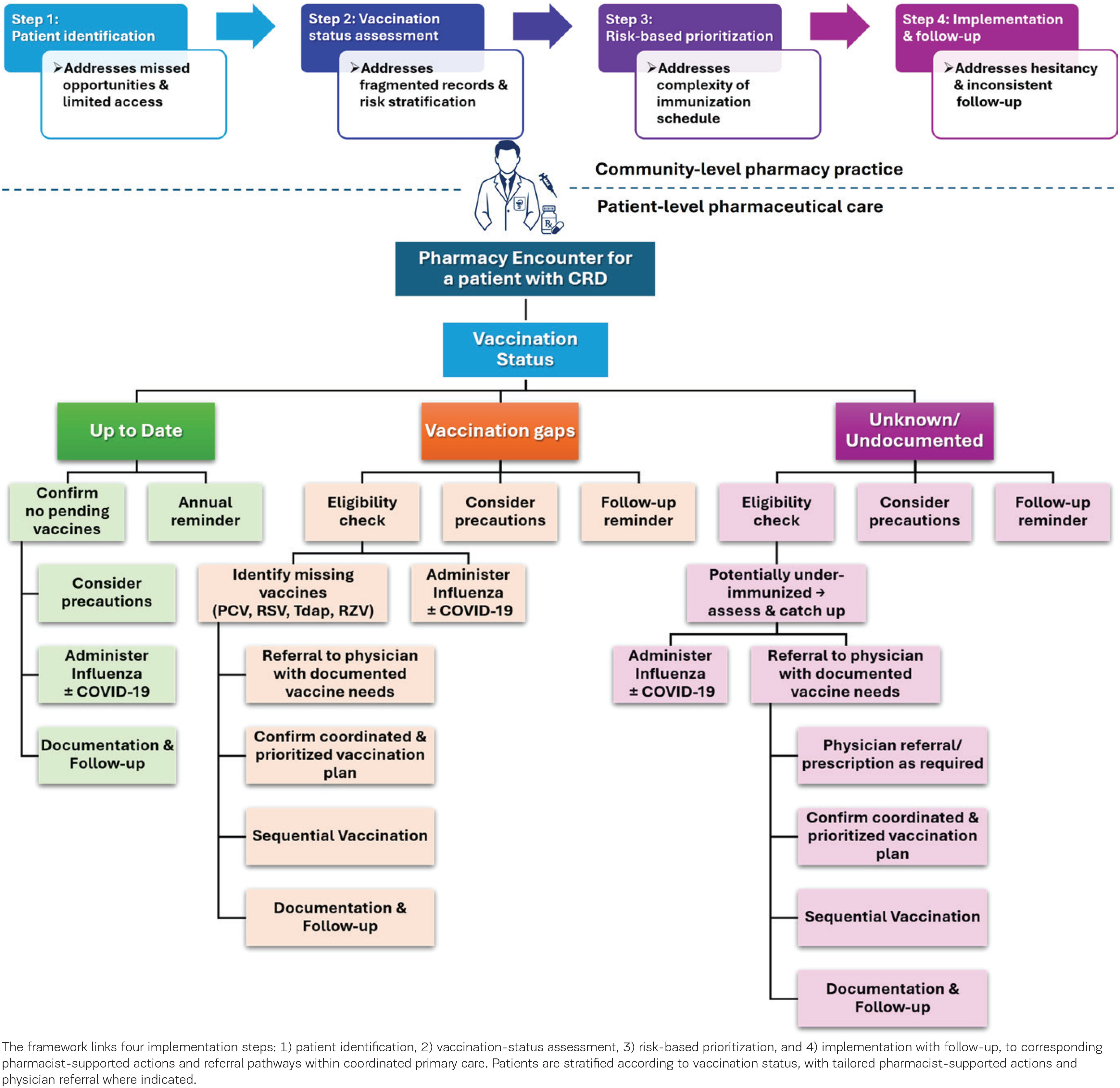
Figure 1 operationalizes this framework by linking the four implementation steps with vaccination-status categories and the corresponding pharmacist-supported actions, including eligibility assessment, prioritization, administration or referral, documentation, reminders, and follow-up. In practice, pharmacists can translate guideline-based recommendations into personalized and context-sensitive actions by providing a strong individualized recommendation with a brief clinical rationale, responding empathetically to questions or misinformation, adapting key messages to the patient’s level of understanding, and reducing missed opportunities through reminders, opportunistic engagement, and appointment scheduling. Patients can then be stratified according to vaccination status as up to date according to current recommendations, having identified vaccination gaps, or having unknown or undocumented vaccination status. In routine pharmacy practice, this framework can be applied during regular CRD-related encounters and seasonal vaccination periods. Its four steps correspond to key implementation gaps in adult immunization. Patient identification addresses missed opportunities and limited access by allowing pharmacists to recognize potentially eligible adults during routine encounters. Vaccination-status assessment addresses fragmented records and incomplete risk stratification by combining available vaccination records, patient-reported information, CRD diagnosis, age, smoking status, comorbidities, current pharmacotherapy, contraindications, precautions, and barriers to uptake. Risk-based prioritization addresses the complexity of adult immunization schedules by linking national recommendations and patient-specific risk to relevant vaccines, including influenza, pneumococcal vaccines, COVID-19, RSV, Tdap, and RZV. Implementation and follow-up address vaccine hesitancy and inconsistent follow-up through evidence-based counselling, access facilitation, physician referral when prescription or additional clinical evaluation is required, vaccine administration when permitted, documentation of outcomes, and reminder-based follow-up. Patients who are up to date need confirmation and continued follow-up, whereas those with identified vaccination gaps require identification of missing vaccines and sequential planning, while patients with unknown or undocumented status should be considered potentially under-immunized until further assessment. Overall, this approach enables community pharmacists to identify and document vaccine needs, refer patients for physician review and prescription when required, and contribute to a coordinated, prioritized vaccination plan. In this way, pharmacy-based vaccination support can strengthen shared decision-making, adherence, interprofessional collaboration, and continuity of care within primary healthcare pathways42,43.
Patient communication and shared decision-making
Effective patient engagement is a key determinant of vaccination uptake among adults with CRDs, where clinical vulnerability may coexist with low perceived risk, uncertainty, or vaccine hesitancy. Within routine primary care encounters, including community pharmacy contacts, structured communication can support vaccine confidence, adherence, and informed decision-making9. In community pharmacy practice, this communication can be integrated into CRD-related encounters such as inhaler prescriptions or refills, inhaler technique consultations, smoking cessation discussions, seasonal respiratory infection periods, or follow-up after exacerbation-related medicines.
Improving vaccination uptake requires more than providing information. A strong, clear, and personalized recommendation from a healthcare professional is one of the most important predictors of vaccine acceptance3. For patients with CRDs, brief patient-tailored messages can connect vaccination to the individual’s respiratory risk profile, age, smoking status, comorbidities, exacerbation history, and incomplete vaccination record. Communication should remain empathetic, accurate, and non-confrontational, particularly when addressing safety concerns, misinformation, or doubts about vaccine effectiveness. Simple key messages, adapted to the patient’s level of understanding, may improve comprehension and acceptance44. Community pharmacists can also reduce practical barriers through opportunistic vaccination-status assessment, reminders, appointment scheduling, and referral when needed. Shared decision-making and motivational interviewing may further support hesitant patients by aligning vaccination decisions with patient values, addressing ambivalence, and reinforcing physician recommendations45,46.
Interprofessional collaboration and continuity of care
Improving adult vaccination uptake in patients with CRDs requires coordinated action across primary care, community pharmacy, public health services, and policy structures. This approach is consistent with emerging proposals to redesign primary care as a network of community-embedded coordination hubs that integrate longitudinal clinical care, interprofessional collaboration, and community engagement47. Primary care physicians, family physicians, and relevant specialists, including pneumonologists, remain central to clinical assessment, diagnosis, vaccine prescription, and individualized risk evaluation. Within this physician-led framework, community pharmacists can support vaccination pathways by identifying eligible patients, reinforcing medical recommendations, facilitating access, and promoting adherence42,43.
This role should not be understood as independent or substitutive, but as collaborative and complementary. Through structured channels of communication and cooperation, prescribing physicians can strengthen the quality of pharmacy-based vaccination support by sharing clinical judgement, patient-specific concerns, and practical experience with pharmacists. In parallel, pharmacists must further develop their scientific knowledge, clinical reasoning, communication skills, and professional responsibility toward patients, so that vaccination counselling is accurate, consistent, and aligned with physician-led care48.
The patient transition from physician consultation to community pharmacy creates opportunities for continuity, but also requires aligned messages, shared documentation, and coordinated follow-up. Evidence from communication-based interventions shows that strong, clear, and personalized recommendations are associated with higher vaccine acceptance and uptake44. Community pharmacists may also strengthen delivery through accessibility, repeated contact with adults living with chronic conditions, and patient trust. In Greece, the high density and wide distribution of pharmacies can facilitate timely access to vaccination-related services, including in semi-urban or underserved areas49. However, accessibility alone is not sufficient. Pharmacist-led interventions are more effective when they are active, structured, and connected to care pathways, including education, eligibility assessment, reminders, counselling, administration where permitted, and coordinated referral9,11,36-38. Their effective integration also requires appropriate training, access to vaccination records, interoperable documentation, clear referral pathways, and safety and pharmacovigilance procedures8,15,16. Such integration may reduce missed opportunities, improve vaccination coverage, and strengthen immunization delivery within primary healthcare systems50.
Strengths and limitations
This review has several strengths. It integrates vaccination guidance, evidence from pharmacist-supported vaccination interventions, and implementation considerations into a pharmacy-practice perspective for adults with CRDs. It also contextualizes international evidence within the Greek primary care setting, where expanding pharmacist access to vaccination records creates new opportunities for structured adult immunization support.
Several limitations should nevertheless be considered. The work was designed as a structured narrative review rather than a formal systematic review or meta-analysis. Accordingly, the literature search was intended to identify key contemporary evidence relative to the review objectives rather than to achieve exhaustive retrieval. Record-level screening and exclusion counts were not prospectively recorded, and no PRISMA-style record flow accounting or formal independent duplicate-screening procedure was undertaken. No quantitative synthesis or formal study-level risk-of-bias assessment were performed. In addition, the available evidence is heterogeneous in terms of study populations, healthcare settings, pharmacist roles, vaccines assessed, intervention intensity and comparators. Many studies also focus on influenza vaccination or mixed adult populations rather than patients with CRDs and most evaluate vaccination uptake rather than clinical outcomes, continuity of care, or documentation quality. Evidence remains limited for CRD-specific outcomes such as exacerbations, hospitalization, safety, cost-effectiveness, equity, and interprofessional continuity. Adult vaccination recommendations also vary between studies and are frequently updated, particularly for COVID-19, RSV and pneumococcal vaccination. Finally, the proposed framework represents an implementation-oriented synthesis and has not yet been prospectively evaluated in community pharmacy practice.
CONCLUSION
Patients with CRDs are at increased risk for vaccine-preventable diseases, making vaccination a key strategy to reduce morbidity and healthcare burden. Bridging the gap between evidence and implementation in adult immunization will depend not only on updated recommendations, but also on their effective integration into everyday clinical practice. Community pharmacists, within a physician-led and interprofessional primary care pathway framework, can support patient identification, education, and delivery of vaccination strategies. The framework offers a practice-oriented pathway for bridging guideline recommendations and real-world vaccination support, although its feasibility and impact require evaluation in routine practice. Future research should evaluate its real-world effectiveness and scalability.